
-1.png)
Weekly recap
What happened in markets
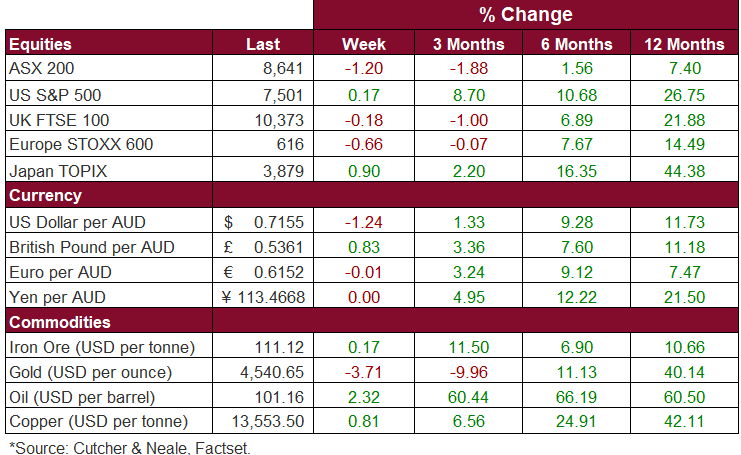
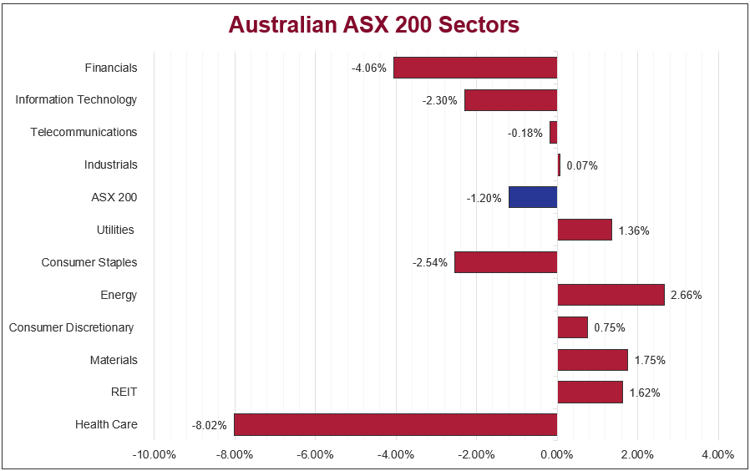
The Australian sharemarket finished lower last week, under pressure from rising bond yields, continued geopolitical uncertainty and mixed company earnings. The ASX 200 fell 1.2% over the course of the week. The Federal Budget came into focus with increased spending seen as mildly inflationary, potentially keeping interest rates higher for longer, which saw bond yields rise. The Health Care sector was the worst performing, as CSL's share price tumbled 18.3% after releasing a downbeat FY26 outlook. The Financials sector was also among the worst performers, driven by CBA’s (-9.4%) latest trading update, as investors focused on margin pressure. As a result, the other big four banks also dragged, with NAB (-4.8%), Westpac (-4.3%) and ANZ (-2.1%) all closing lower. On the other hand, Energy (2.7%) and Materials (1.8%) lifted, supported by higher commodity prices.
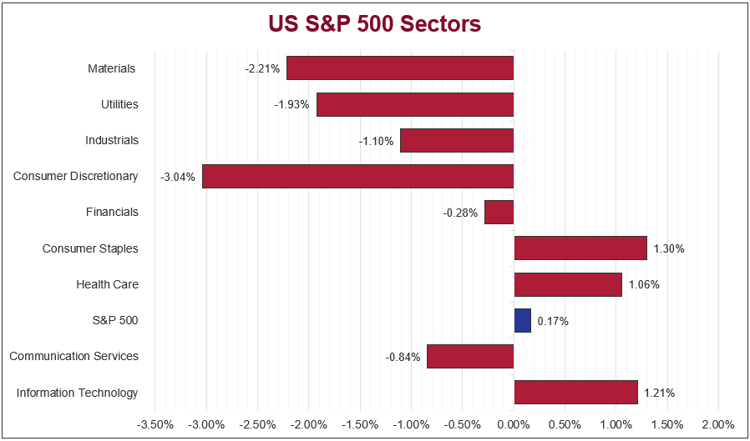
US sharemarkets finished the week slightly higher, as gains in large technology stocks were offset by broader investor caution around higher interest rates and inflation. Gains in the Technology sector (1.2%) were fairly concentrated, with NVIDIA (4.7%) extending gains ahead of its upcoming earnings announcement. Treasury yields pushed above multi year highs, following stronger than expected April inflation data. The Consumer Discretionary sector was under pressure, giving up 3.0%, as higher petrol prices, increased energy costs and rising inflation raised concerns that discretionary spending could come under pressure in the coming months. Eli Lily was a stock specific standout, supported by strong demand for its diabetes and obesity treatments, coupled with its strong defensive nature, pushing the share price 6.1% higher.
European sharemarkets declined over the week. Higher oil prices, driven by ongoing Middle East disruptions, reinforced inflation concerns and pressured interest‑rate‑sensitive sectors. UK markets underperformed amid political instability and a sharp rise in government bond yields, while broader European sentiment remained cautious despite a generally solid earnings season. Sector performance was mixed, with the Communications (1.7%) and Energy (0.9%) sectors outperforming as investors favoured defensive and commodity‑linked exposures. In contrast, the Retail (‑4.1%) and Construction (‑3.8%) sectors lagged, reflecting concerns around higher input costs, weaker consumer demand and slowing economic growth. Overall, investors remained selective as growth risks and inflation pressures continued to dominate the outlook.
Stock & sector movements

What caught our eye
In our pre-Budget commentary, we argued that this was crunch time for tough choices. Inflation is sticky, productivity weak, government spending high and housing supply still the pressure point. This Budget does make some hard choices and Labor Treasurer Jim Chalmers did take political risk. While it remains to be seen, we don’t think it was worth it.
Winners & Losers
Winners are first home buyers, taxpayers receiving the new Working Australians Tax Offset, patients, small businesses and, arguably, the Budget’s bottom line if the NDIS savings are delivered. The losers are property investors, wealthier households, trust users and perhaps most importantly, trust in the policy process. Labor had said not too long ago that it would not touch negative gearing and capital gains tax (CGT). They now have. That does not necessarily make the policy wrong, but it does undermine trust.
Tax Reform
The centerpiece is asset tax reform. Negative gearing will be restricted for existing properties, the 50% CGT discount will be replaced by an inflation-based model, and a 30% minimum tax rate will apply to capital gains and discretionary trust distributions. Existing assets are largely grandfathered, which is politically practical, but generationally awkward. Younger investors will now come through under a tougher set of rules, while many older asset owners retain the benefits of the old system. To some, it may feel like pulling the wealth ladder up.
The government’s argument is that the tax system has favoured assets over labour for too long. There’s some truth to that. But the trade-off looks underwhelming for workers. A $250 annual offset, paid in a years’ time, feels thin beside reforms that will materially change the after-tax return from long-term investing. The other staged income tax cuts were already promised before this Budget.
Housing
Housing is the Budget’s main selling point. Helping fund infrastructure for new homes is welcome and directing tax incentives away from established property and towards new builds makes sense in theory. But will it move the dial? Chalmers said changes made will lead to another 65,000 homes being built over the next decade. That is definitely useful, however, against Australia’s population growth and migration pressures it is unlikely to meaningfully reset affordability. Keep in mind net migration in FY2025 was +306,000 people. So, demand is still running hard and supply takes years to appear.
NDIS
NDIS cuts are a positive and necessary step from a financial standpoint. The scheme’s growth rate was unsustainable, and the Budget is counting on $38 billion in savings over four years, derived from eligibility tightening, plan reassessments and fraud controls. The aim is to slow nominal NDIS cost growth from 10% to 2%. That is meaningful and will deserve some credit if achieved.
Productivity
Productivity is a key disappointment. Australia’s living standards will not be improved by moving tax concessions from one group to another. It needs more output per hour worked, better infrastructure, faster housing approvals and a tax system that rewards effort and risk-taking. Minor instant asset write-offs for small businesses and more taxes on all asset investment isn’t a step in the right direction here.
Pulling it all together
This Budget is clearly aimed at addressing perceived inequality in the tax system. Asset owners will pay more and workers will pay less. Future asset owners, not prior or existing ones, will pay the most. Today’s workers receive a modest sweetener, but don’t forget they’re tomorrow’s investors, who now face tougher rules. More housing supply is welcome, but unlikely to be enough against strong population growth. And most disappointing, productivity was largely ignored, despite Chalmers’ roundtable on it late last year. That matters because without productivity, the country is left arguing over how to divide a pie that is not growing quickly enough.
The week ahead
Locally, the focus will be on the April labour market data, with the unemployment rate expected to remain unchanged at 1.3%. Additionally, we will hear from assistant RBA Governor and receive the latest RBA meeting minutes.
Overseas, attention will turn to the US Federal Reserve's meeting minutes, alongside a range of US housing, employment and business activity data, which will help shape expectations around inflation and monetary policy. Markets will also be closely watching NVIDIA’s earnings result, which is expected to be a key driver for global technology stocks during the week.


Wade is the head of the Investment Services division at Cutcher & Neale and has over 15 years of industry experience in accounting and investment advisory roles.
Wade guides his division on the belief that investment portfolios should be built on transparency and flexibility. His expertise focuses on direct portfolio exposure to both Australian and Global Investment markets.
-1.png?width=352&name=Investment%20SnapShot%20Header%20-%20July%202025%20(1)-1.png)