
-1.png)
Weekly recap
What happened in markets
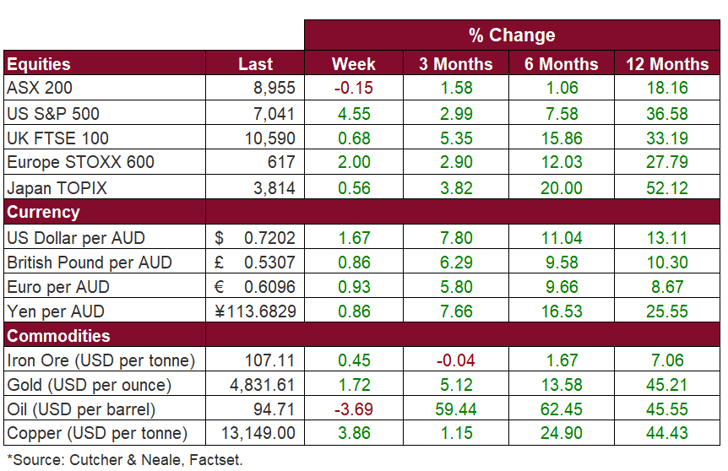
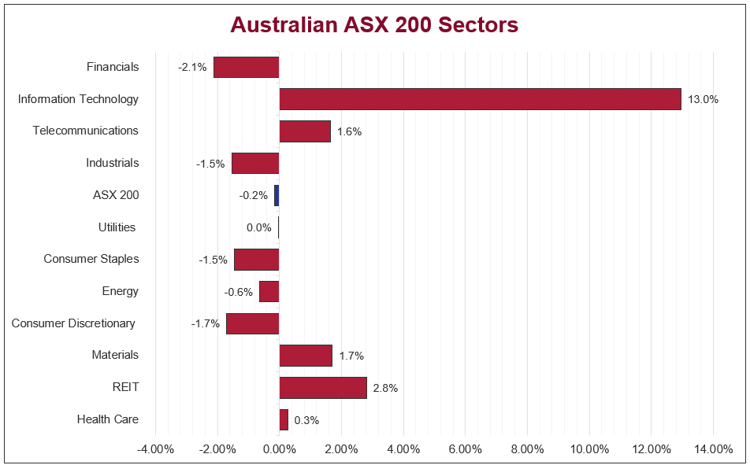
The Australian sharemarket finished the week broadly flat, with the ASX 200 down -0.2% as strong early-week volatility eased and investors consolidated recent gains amid shifting global sentiment. Markets were influenced by developments in US-Iran negotiations, which drove swings in oil prices and briefly lifted inflation concerns before sentiment stabilised. The Information Technology sector (13.0%) was the standout performer, extending its rebound on continued strength in AI-related stocks. The REITs sector (2.8%) also rose, supported by easing bond yields, while Materials (1.7%) edged higher. In contrast, Energy (-0.6%) lagged as oil prices retreated, while Financials (-2.1%) also softened toward the end of the week.
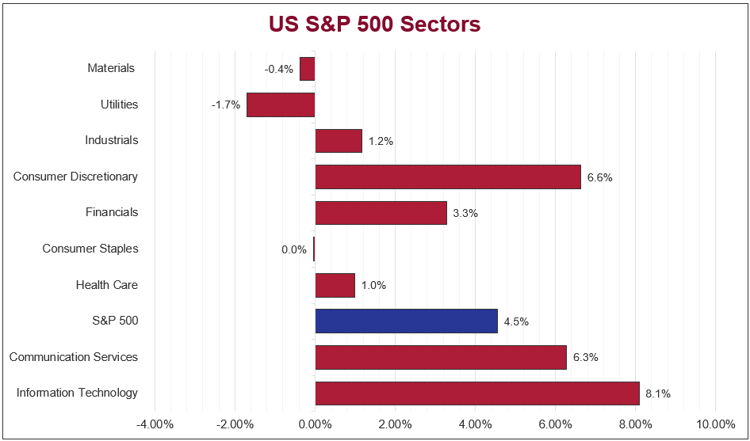
US sharemarkets surged over the week, with the S&P 500 up 4.5% and the NASDAQ rising 1.5%. Sentiment was supported by easing US-Iran tensions, which pushed oil prices lower and helped reduce inflation concerns. The Information Technology sector (8.1%) led the rally, followed by Consumer Discretionary (6.6%) and Communication Services (6.3%), driven by continued strength in AI-related names. In contrast, the Energy sector (-3.5%) lagged, weighed down by falling crude prices, while supportive economic data and strong investor positioning underpinned the broader market strength.
European sharemarkets also posted continued gains over the week, following strength in US equities, with the STOXX Europe 600 rising 2.0% as risk appetite improved globally. Easing geopolitical tensions, including progress toward a US-Iran ceasefire and reopening of key shipping routes, helped drive oil and gas prices lower, easing inflation concerns and supporting equities. The Technology sector (6.3%) led gains, followed by Financial Services (5.9%) and Construction & Materials (3.7%), supported by strong earnings momentum and improving sentiment. In contrast, the Energy sector (-4.0%) lagged as crude prices declined sharply, while Utilities (-3.9%) and Telecommunications (-2.0%) also underperformed relative to cyclicals.
Stock & sector movements

What caught our eye
Stagflation is back on watch, but equities may still prove resilient
Stagflation is one of those market words that tends to make investors sit up a little straighter. And for good reason. A world of slower growth, higher inflation and limited central bank flexibility is an uncomfortable place to be.
That is why the latest Gulf tensions have caught investors’ attention. Higher oil prices, shipping disruption and the possibility of a prolonged issue around the Strait of Hormuz have all raised the risk that this becomes more than just another geopolitical flare-up. If energy prices stay elevated for long enough, the pressure can spread well beyond the petrol bowser, into transport, supply chains, business costs and, eventually, consumer demand.
Still, it is important not to jump straight to the conclusion that stagflation is now the base case.
Two forces are shaping markets
The better way to think about the current backdrop is as a tug-of-war between two forces. On one side sits the macro risk of weaker growth, sticky inflation and central banks that may be slower to ride to the rescue. On the other sits an underappreciated market support. Equity valuations have already come down, while earnings expectations have, so far, been more resilient than many might have expected.
Why valuations and earnings both matter
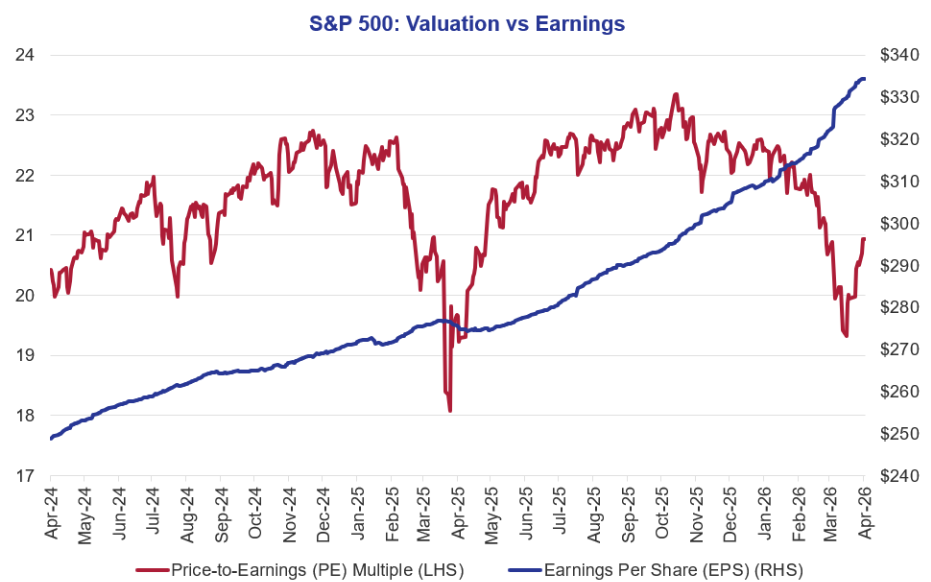
When markets fall because earnings are collapsing, it is usually a warning that the fundamental backdrop is deteriorating quickly. But when markets fall because valuations compress while earnings remain intact, the story can be quite different. In those periods, the drawdown can reflect fear and uncertainty rather than the start of a deep and lasting earnings recession.
Markets have already priced in a fair amount of bad news through lower price-to-earnings multiples, while earnings expectations have remained relatively resilient. That does not remove the risk, but it does suggest equities are entering this period from a firmer starting point than the headlines alone might imply.
The key swing factor: Energy
The real swing factor from here is whether the energy shock persists.
If Gulf hostilities drag on, oil remains high and inflation pressures become more embedded, central banks could find themselves in a bind. Normally, weaker growth opens the door to rate cuts. In a stagflation-style environment, that option becomes less straightforward, because easing too quickly risks adding to inflation pressure. That is one reason stagflation is so awkward for markets. Policy support becomes less reliable just when investors would usually hope for it most.
A selective market, but not necessarily a broken one
There is still another path. If tensions ease, the Strait of Hormuz avoids lasting disruption and oil prices retreat before broader economic damage is done, the current episode may end up looking more like a geopolitical valuation reset than the beginning of a serious downturn.
That would not be an all clear for risk assets, and the impact is unlikely to be evenly spread. Some sectors remain far more exposed to higher input costs, weaker consumers and margin pressure than others. In our view, this is a market that rewards selectivity, particularly where businesses have pricing power, resilient margins and strong balance sheets.
Our takeaway is straightforward. Stagflation is back on watch, and it deserves respect. But it remains a risk scenario rather than a foregone conclusion. If the shock proves temporary, energy markets normalise, and earnings remain resilient, equities may yet come through this period in better shape than the headlines suggest.
The week ahead
Locally, focus will be on the Westpac Leading Index and April PMI data, which will provide an update on economic momentum and business conditions across Australia.
Overseas, attention will be on US retail sales and labour market data, alongside Federal Reserve Chair-Designate Kevin Warsh’s testimony, which may provide further insight into the outlook for growth, inflation and interest rates. Markets will also be watching the reaction to Iran’s closure of the Strait of Hormuz late Saturday, for any impact on energy prices and global sentiment.


Wade is the head of the Investment Services division at Cutcher & Neale and has over 15 years of industry experience in accounting and investment advisory roles.
Wade guides his division on the belief that investment portfolios should be built on transparency and flexibility. His expertise focuses on direct portfolio exposure to both Australian and Global Investment markets.
-1.png?width=352&name=Investment%20SnapShot%20Header%20-%20July%202025%20(1)-1.png)