Weekly recap
What happened in markets
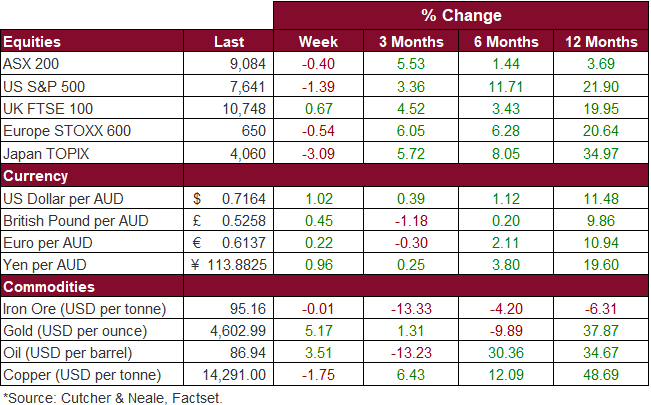
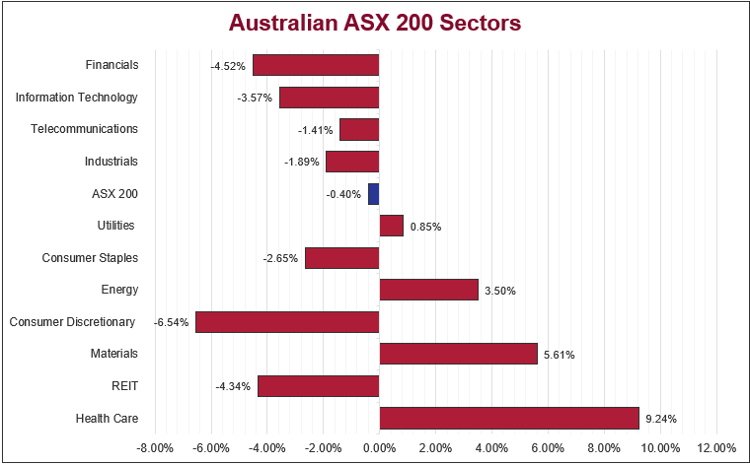
The Australian sharemarket finished the week lower, with the ASX 200 declining 0.4%, as rising bond yields, persistent inflation concerns and a busy earnings season weighed on sentiment. The market fell for six straight sessions before rebounding on Thursday, with investors digesting softer employment data and mixed corporate results. The Healthcare sector was a standout, surging 9.2%, led by strong earnings from CSL (23.3%), Cochlear (1.4%) and Pro Medicus (7.1%) all beating earnings expectations. The Materials sector also outperformed, supported by a rally in gold miners as bullion prices climbed. Newmont rose 11.4%, while diversified miners BHP and Rio Tinto added 6.2% and 4.7% respectively. Energy stocks were supported by elevated oil prices linked to Middle East tensions. Consumer Discretionary was the weakest performer, due to mixed earnings results and signs of softer consumer spending. JB Hi-Fi was among the biggest detractors, falling 15.3%.
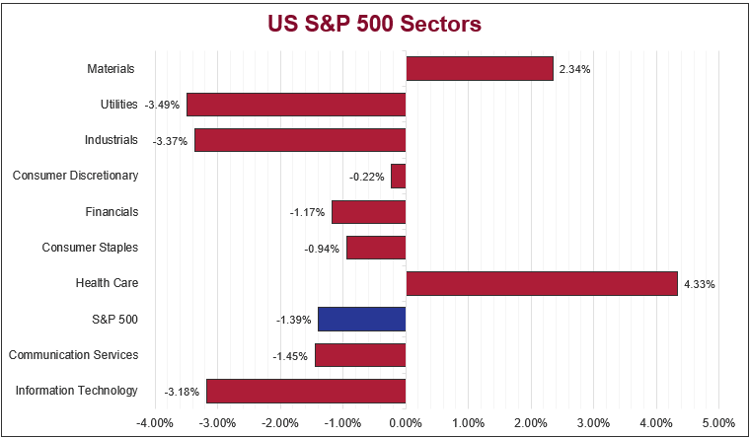
US sharemarkets also ended the week lower, snapping a three-week winning streak as investors grappled with rising long-term bond yields, higher oil prices and signs of fatigue in AI-related momentum trades. Sharemarkets were pressured by rising long-term bond yields, with the 30 year yield hovering around the highest levels seen since 2007, which made investors less willing to pay premium valuations, particularly for technology and other growth-focused companies. As a result, interest rate sensitive sectors including Information Technology (-3.2%), Utilities (-3.5%) and Industrials (-3.4%) all finished lower. On the other hand, the Healthcare (4.3%) sector gained strongly following positive biotechnology developments from Moderna and Merck, including major advances in melanoma treatments. While Materials also rose, as the price of gold rallied 5.2%, as investors sought alternative stores of value.
European sharemarkets were mixed over the week, with the STOXX Europe 600 falling 0.5% as surging long-term bond yields overshadowed encouraging economic data, while the UK's FTSE 100 gained 0.7%. Stronger-than-expected business activity surveys across the Eurozone and UK pointed to improving economic momentum, particularly in manufacturing, but investors remained concerned about elevated borrowing costs. French political uncertainty also remained in focus amid concerns around government finances and upcoming budget negotiations, while higher energy prices linked to the Iran conflict added to market caution. Technology, banks and other rate-sensitive sectors lagged as bond yields climbed to multi-year highs. In contrast, the Basic Resources sector was a bright spot, advancing 5.3%. Swedish industrial company Sandvik AB rose 6.0%, supported by the announcement of a significant international mining equipment order.
Stock & sector movements

What caught our eye
The AI Spending You Can't See
The US’ largest technology companies reported about US$600 billion of capital spending over the past year, much of it on artificial intelligence. According to the Wall Street Journal, there are a further US$3 trillion of commitments that never appear on their balance sheets.
Clearly the published numbers no longer tell the full story. Looking through footnotes in the financials of nine big technology companies, including Alphabet, Amazon, Meta, Microsoft, Oracle and Nvidia, we find roughly US$1.2 trillion of leases that have been signed but not yet commenced. That’s about four times the figure of a year earlier. We also found around US$1.9 trillion of purchase commitments for chips, equipment and energy. Accounting rules keep these obligations off the balance sheet until rent starts being paid or goods are delivered.
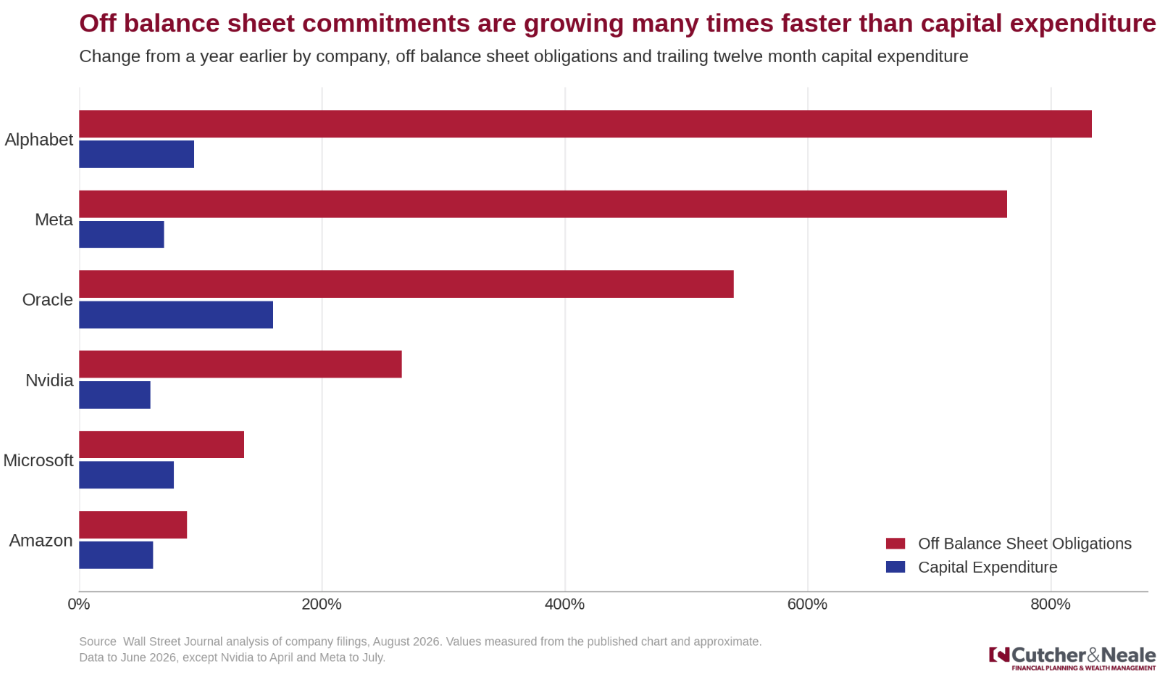
Meta's enormous Hyperion data centre in Louisiana, a site covering the equivalent of roughly 1,700 football fields, is a good example. Its lease does not begin until 2029, so the obligation sits in a footnote for now. Meta's disclosed total for leases not yet started has reached US$347 billion.
Microsoft's latest result showed how accounting choices can widen the gap further. From 2027 the company will assume its data centres last 25 years rather than 15, a change that moves many future leases into a category that no longer counts as capital expenditure. That single adjustment trimmed roughly US$15 billion from its capital spending guidance for this calendar year. Microsoft was upfront that its investment plans were unchanged and its June quarter capital spending still rose 69% to US$41 billion.
Alphabet's purchase commitments jumped from US$332 billion to US$811 billion in a single quarter, with some energy agreements stretching out to 2054. Most of these obligations cannot be cancelled, so the money is owed whether or not the anticipated AI revenue arrives on schedule.
Morgan Stanley's accounting analysts warned earlier this year that arrangements like these are making it even harder for investors to judge how much borrowing and obligation these companies truly carry. When two companies report similar capital spending but very different footnotes, the headline comparison becomes misrepresented.
For investors, none of this means the AI story is broken. Demand signals remain genuinely strong. What it means is that headline capital expenditure has become less reliable and these companies are spending (or at least committing to spending) much more than many investors think. It seems the scale of this investment cycle is now best measured in the footnotes and that is where we will keep looking.
The week ahead
Locally, attention will remain on the final week of the Australian reporting season, with heavyweights Coles, Woolworths and Wesfarmers all set to release. Additionally, the all-important monthly inflation data will be closely watched, along with household spending.
Overseas, the world’s largest company, NVIDIA, is set to release its latest earnings on Wednesday, which will attract lots of attention. There is also a raft of economic data, which will give us a read into the state of the economy including manufacturing data, personal consumption expenditure and weekly jobless claims. Finally, central bankers, policymakers and economists from all over the world will come together to meet for the annual Jackson Hole Economic Symposium from Thursday to Saturday.


Wade is the head of the Investment Services division at Cutcher & Neale and has over 15 years of industry experience in accounting and investment advisory roles.
Wade guides his division on the belief that investment portfolios should be built on transparency and flexibility. His expertise focuses on direct portfolio exposure to both Australian and Global Investment markets.
-1.png?width=352&name=Investment%20SnapShot%20Header%20-%20July%202025%20(1)-1.png)