
Weekly recap
What happened in markets
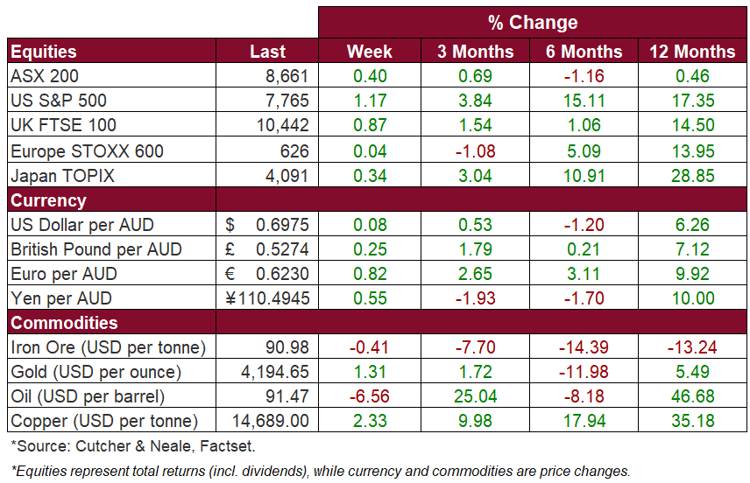
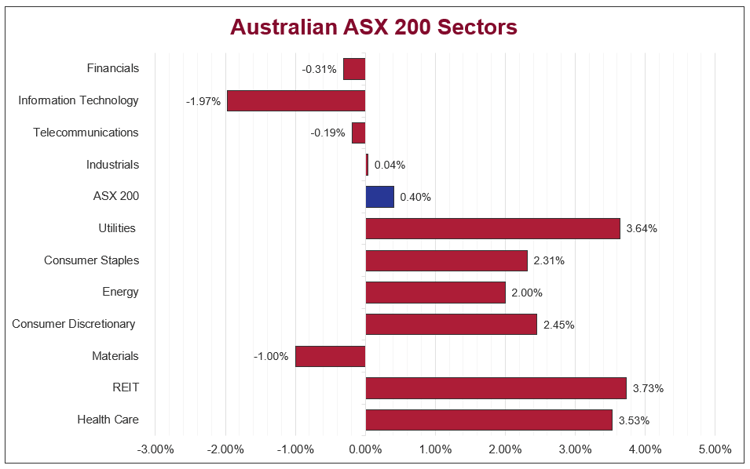
The Australian sharemarket edged higher over the week, with the ASX 200 gaining 0.40%, although performance beneath the headline index was considerably stronger across several sectors. The REITs sector led the market with a 3.7% gain, accompanied by improving short-term momentum across the sector during the week. Defensive areas of the market also performed strongly, with the Utilities (+3.6%) and Health Care (+3.5%) sectors among the week's best performers. The Consumer Discretionary (+2.5%), Consumer Staples (+2.3%) and Energy (+2.0%) sectors also recorded solid advances. Conversely, Information Technology (-2.0%) and Materials (-1.0%) were the primary detractors, while Financials (-0.3%) and Telecommunications (-0.2%) recorded more modest declines. Industrials were largely flat.
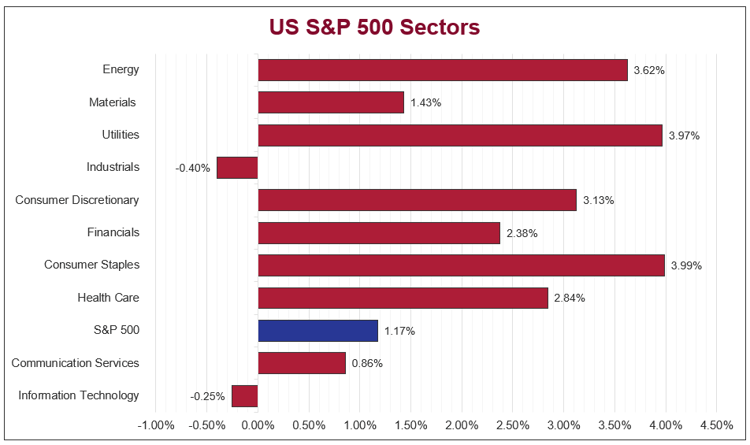
US sharemarkets advanced over the week, with the S&P 500 gaining 1.17%, despite Treasury yields remaining elevated amid continued inflation and interest-rate concerns. The US 10-Year Treasury yield ended the week at approximately 5.2%, having reached its highest level in more than two decades earlier in the week. Market leadership broadened considerably, with Consumer Staples (+4.0%), Utilities (+4.0%), Energy (+3.62) and Consumer Discretionary (+3.1%) leading gains. Health Care (+2.8%) and Financials (+2.4%) also performed strongly, while Information Technology (-0.3%) and Industrials (-0.4%) were the only sectors to decline. Technology shares experienced some volatility amid renewed concerns around AI valuations, while weakening US consumer sentiment provided a softer macroeconomic backdrop. Overall, the week's advance was considerably broader than the previous technology-led rally, demonstrating continued resilience across US equities despite elevated borrowing costs.
European sharemarkets finished the week broadly flat, with the STOXX Europe 600 gaining just 0.04%, masking considerable variation across sectors. The Energy (+3.0%) sector led the market as oil prices remained elevated, while the Basic Resources (+1.7%), Retail (+1.5%) and Financial Services (+1.44%) sectors also recorded solid gains. In contrast, the Telecommunications (-2.8%), Banks (-2.3%) and Construction & Materials (-2.3%) sectors were the largest detractors. European markets continued to contend with elevated borrowing costs and inflation concerns, alongside uncertainty surrounding France’s fiscal outlook, which contributed to volatility across government bond markets during the week. Overall, the broadly flat headline results masked significant sector dispersion, with energy and resource-related shares outperforming, while financial and interest-rate-sensitive areas of the market came under pressure.
Stock & sector movements
What caught our eye
Weaker Jobs, Firmer Prices and a Narrower Path for Central Banks
Last week's economic data from the United States and Europe pulled in two different directions. Hiring slowed noticeably while prices kept climbing, leaving central banks with less room to manoeuvre than markets may be assuming.
The US labour market is clearly losing momentum. Employers added just 29,000 jobs in September, well short of the 90,000 economists had forecast, and a further 60,000 jobs were removed from earlier months once the figures were revised. Unemployment edged up to 4.2%. Households are feeling it too, with consumer confidence falling to 81.9 when a reading of 89.0 was expected. On their own, these numbers would normally strengthen the case for lower interest rates.
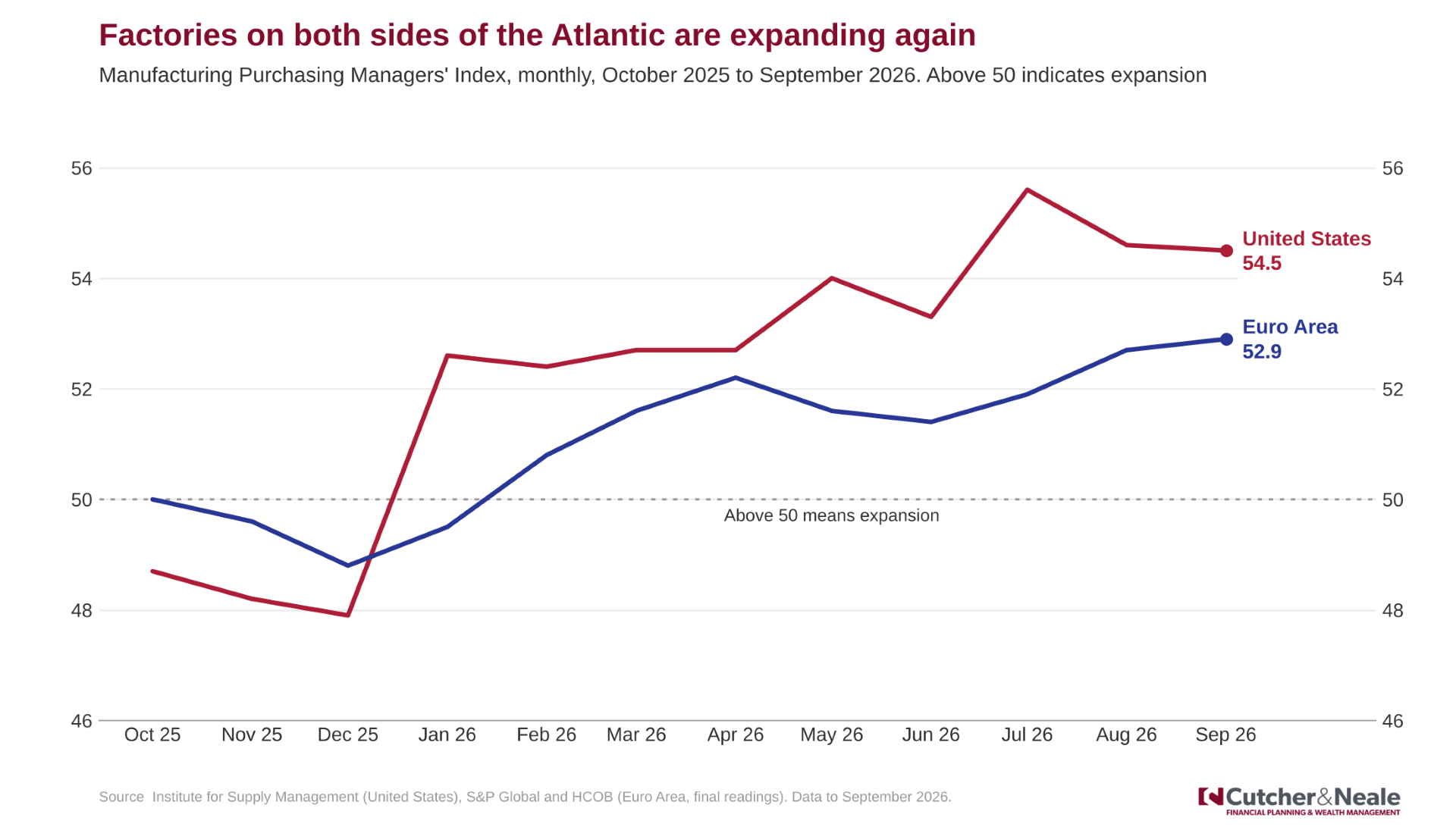
The difficulty is that inflation has not followed the jobs market lower. The prices component of the ISM manufacturing survey, which tracks what factories are paying for their materials, rose sharply to 77.9 from 71.1. That tells us cost pressures are building in supply chains rather than fading. Core PCE inflation, the Federal Reserve's preferred gauge, came in at 3.0% against an expected 3.3%. At first glance that looks like welcome relief. But the previous month was revised down by the same margin, so the apparent improvement reflects changes to the earlier figures rather than a genuine cooling in prices. Annual revisions also lifted US economic growth in the second quarter to 2.2% from 1.5%, which shows the economy has had more underlying strength than first reported.
Europe adds weight to this picture. Headline inflation rose to 3.8% from 3.2%, while core inflation, which strips out volatile food and energy costs, held at 2.5%. The gap between those two numbers shows energy is doing much of the work. Europe is where the role of energy is clearest.
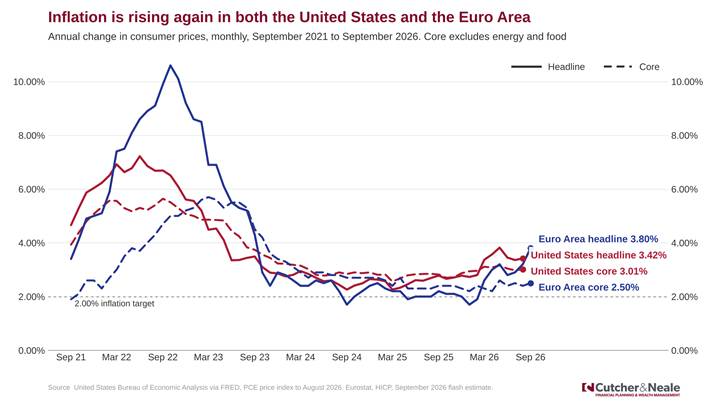
Put together, central banks face a harder choice than they did a few months ago. Cutting interest rates to support a softening jobs market risks letting inflation settle at a higher level, while holding firm risks adding pressure on jobs.
For investors, this suggests patience and balance matter more than positioning for any single outcome. Portfolios built around the expectation of rapid rate cuts may be disappointed if inflation stays firm, while those braced only for a downturn could miss the resilience still evident in growth (supported by Artificial Intelligence). We are watching energy costs and business input prices closely because they will shape the timing of any change in policy. A diversified portfolio is best placed for a period in which the economic signals remain mixed.
The week ahead
This week in Australia, focus is on the labour market and unemployment rate figures. In the US, CPI and inflation data will take precedent Wednesday and Thursday a large array of data gets released including PPI and retail sales.


Wade is the head of the Investment Services division at Cutcher & Neale and has over 15 years of industry experience in accounting and investment advisory roles.
Wade guides his division on the belief that investment portfolios should be built on transparency and flexibility. His expertise focuses on direct portfolio exposure to both Australian and Global Investment markets.