
-1.png)
Weekly recap
What happened in markets
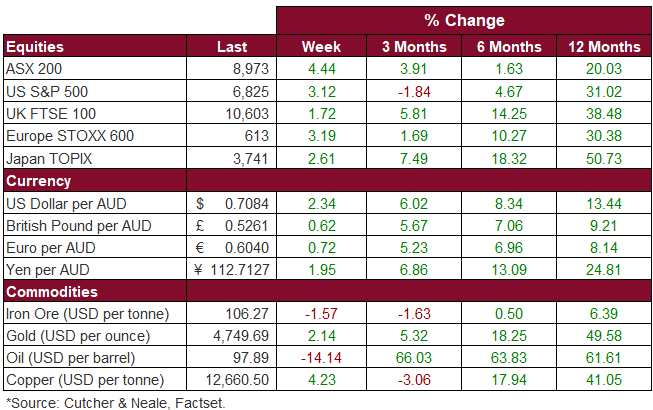
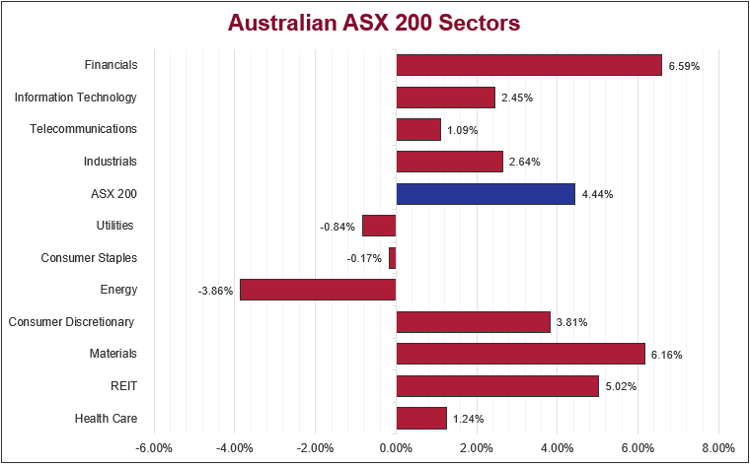
The Australian sharemarket performed strongly last week, surging 4.4% in the shortened 4 day trading week. This marked the ASX 200’s best week in over a year, supported by improving global sentiment following a temporary ceasefire in the Middle East. As a result, concerns around an energy crisis and increased inflation began to cool. Investors started to rotate back into cyclical sectors, which saw the Materials and Financials sectors rally 6.2% and 6.6% respectively, while Real Estate (5.0%) also rose. Data centre company, Nextdc, was a standout performer, advancing 13.9%, after they secured a $1 billion capital raise, which will go towards their plans to spend $2.7 billion on building new data centres.
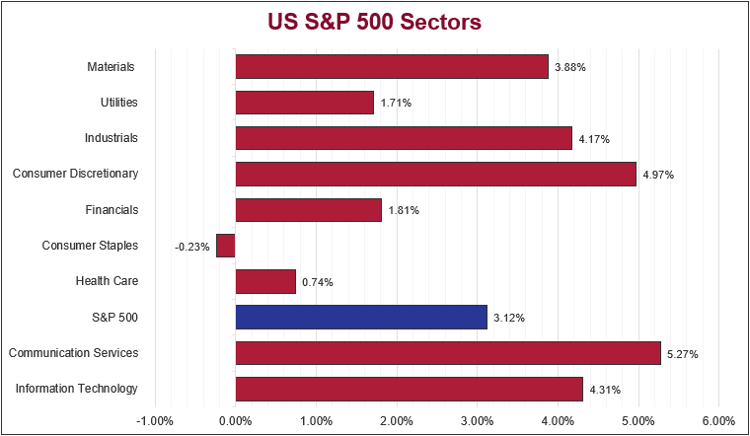
US sharemarkets rose strongly over the week, with all major indices posting solid gains as risk appetite improved. Markets were driven primarily by geopolitical developments, as a ceasefire between the US and Iran reduced immediate energy and inflation risks, sending oil prices sharply lower, supporting a relief rally. The Communication Services (5.3%) and Consumer Discretionary (5.0%) sectors led the gains, while large technology stocks also performed strongly, thanks to continued enthusiasm around artificial intelligence and strong earnings updates. US chip company, Broadcom, was among those positive performers, adding 18.2%, after reporting a 29% year over year increase to revenue. While commentary from the US Federal Reserve remained cautious, slightly cooler inflation data helped reassure investors that interest rate cuts remain possible later in the year.
European sharemarkets also finished the week higher, extending gains for a second consecutive week, although volatility remained elevated. The STOXX Europe 600 rose 3.2%, as investors responded positively to signs of de‑escalation in Middle East, which drove a sharp pullback in oil and gas prices. This helped ease inflation concerns, which reduced expectations for further interest rate hikes from the European Central Bank and Bank of England. Cyclical sectors outperformed, which saw Banks (6.8%) and Materials (5.9%) rise, as investors started rotating back into higher‑risk areas of the market. Despite the rally, sentiment remained cautious, with economic data pointing to slowing growth across parts of Europe.
Stock & sector movements

What caught our eye
Markets Want Peace. Oil Wants Proof.
Markets have done what markets often do in a crisis. They have rushed to price in the possibility of calm before the hard work of calm has actually arrived. Yes, global equities bounced on hopes that the Iran ceasefire might hold and that Israel and Lebanon could move toward direct talks. But the more important signal is coming from shipping and oil, and that signal is still flashing amber.
Hormuz is still the real story
The key issue is the Strait of Hormuz. Roughly a fifth of the world’s oil typically moves through that narrow waterway, yet traffic remains a fraction of normal levels despite the ceasefire headlines. Reuters reported that ship movements have fallen to less than 10% of usual volumes, with Iran asserting tight control over the passage, while the UN’s shipping agency has warned that any toll regime would be a dangerous precedent under international maritime law. In other words, this is not a normalisation story yet. It is a rationing story.
That matters because oil is reacting less to diplomacy and more to logistics. Brent and WTI have both rebounded as investors recognise that a ceasefire on paper does not mean barrels are flowing freely in practice. Barclays has warned that any delay in restoring Hormuz flows creates upside risk to oil prices, and Saudi Arabia’s own supply picture has become less reassuring after attacks cut output capacity and reduced flows on the East-West pipeline, one of the few routes that can bypass Hormuz.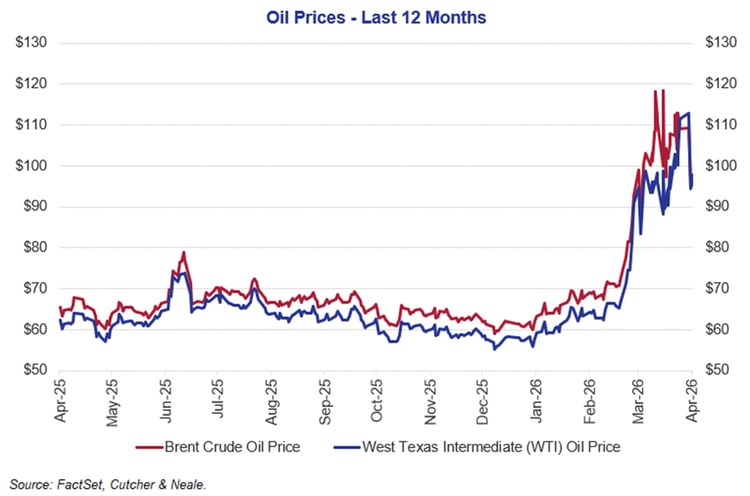
What it means for investors
There is a second market lesson here. Equity investors appear willing to look through a lot of geopolitical noise so long as they can imagine a diplomatic off-ramp. That helps explain why Wall Street could rise even as oil stayed elevated and Treasury yields barely moved. But we think that optimism is fragile. If the real economy keeps wearing higher energy costs, through freight, fuel, food and inflation expectations, the relief rally in shares may prove ahead of itself. US inflation data already showed price pressures staying too firm for comfort in February, and the IMF is warning that the war will leave lasting economic scars even if peace is reached.
For investors, the takeaway is straightforward. This is still a markets-versus-molecules story. Markets are trading headlines about talks in Islamabad, pressure on Israel to curb strikes in Lebanon, and even China’s emerging diplomatic role. Molecules, however, still need safe shipping lanes, insurance cover, functioning export routes and political clarity. Those are harder to restore than confidence on a trading screen.
Our view is that caution remains the right posture. The bounce in shares is understandable, but the more reliable guide for now is oil’s refusal to relax. Until Hormuz is genuinely open, not just theoretically open, investors should assume volatility remains part of the package. That is also a reminder of why diversification remains so important. When markets are being pulled around by geopolitics and energy shocks, balance across asset classes and regions can matter more than trying to predict the next headline.
The week ahead
Locally, attention will be on labour force data for March, with the unemployment rate expected to hold at 4.2%, providing an important update on labour market conditions. Markets will also watch consumer and business confidence readings, for signals on household and business sentiment. In addition, Reserve Bank of Australia officials will speak in the US, which may offer insight into the outlook for inflation and interest rates.
Overseas, the focus will be on US inflation pressures, with the release of the Producer Price Index and Industrial Production data. In China, key economic updates include GDP, Retail Sales and unemployment figures.


Wade is the head of the Investment Services division at Cutcher & Neale and has over 15 years of industry experience in accounting and investment advisory roles.
Wade guides his division on the belief that investment portfolios should be built on transparency and flexibility. His expertise focuses on direct portfolio exposure to both Australian and Global Investment markets.
-1.png?width=352&name=Investment%20SnapShot%20Header%20-%20July%202025%20(1)-1.png)