
Weekly recap
What happened in markets
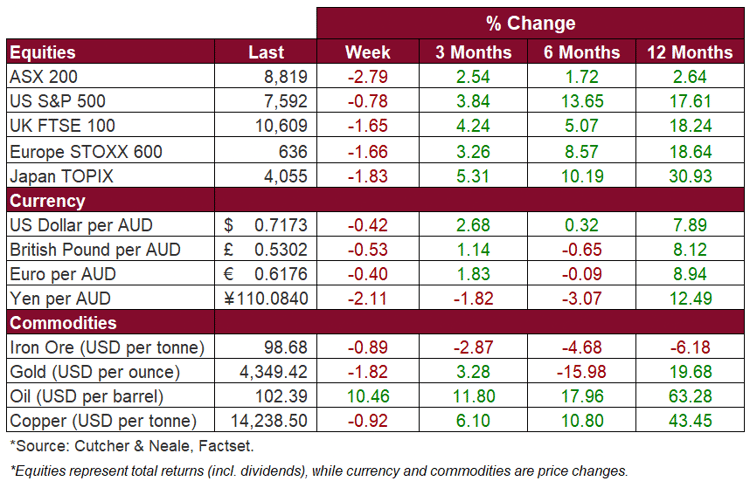
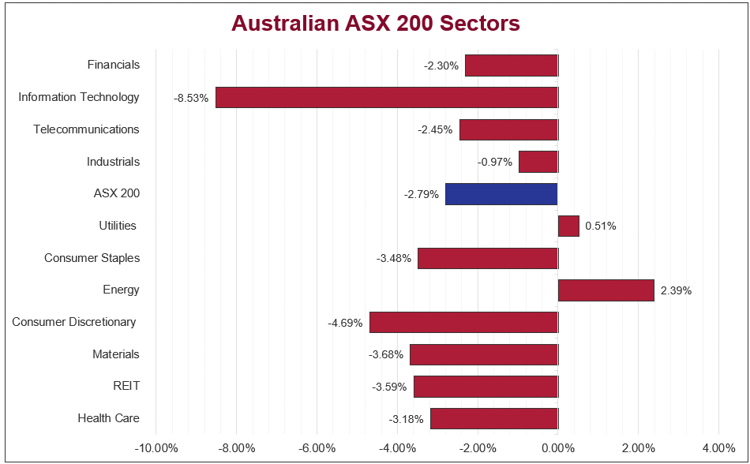
The Australian sharemarket closed the week lower, with the ASX 200 down 2.79% as volatility picked up amid continued geopolitical unrest in the Middle East, alongside concerns over rising global debt levels, inflation and surging global bond yields. The Energy sector (2.39%) benefitted from rising oil prices, while the Utilities sector (0.51%) also outperformed as investors continued rotating towards defensive stocks. In contrast, the Information Technology sector (-8.53%) underperformed sharply, with large-cap technology stocks such as Xero (-15.52%) and Wisetech (-12.81%) among the biggest detractors. Additionally, the Materials (-3.68%), Consumer Discretionary (-4.69%), REIT (-3.59%) and Health Care (-3.18%) sectors all struggled.
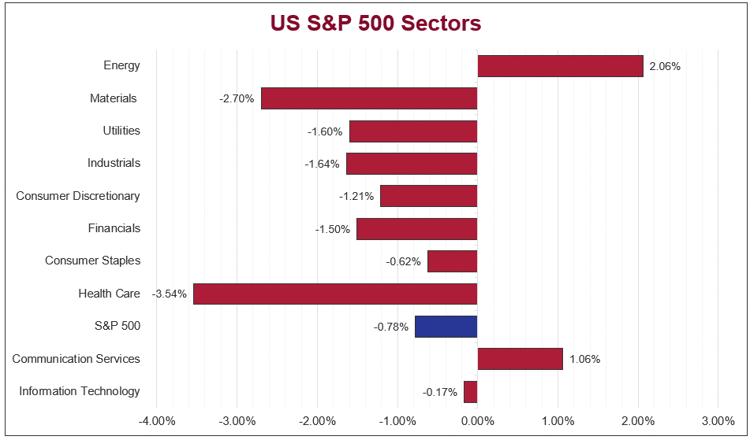
US sharemarkets edged lower over the week, with the S&P 500 finishing down 0.78% and the NASDAQ down 0.70%. The Energy sector (2.06%) led the way, supported by rising energy prices from the Middle East conflict, while the Communication Services sector (1.06%) was the only other sector to finish the week in the green. The Health Care (-3.54%), Materials (-2.70%), Industrials (-1.64%) and Financials (-1.50%) sectors all finished lower. August CPI data held steady at 3.4%, pushing inflation expectations higher and lifting the likelihood of a Federal Reserve interest rate increase to 85%. This comes as bond investors continue to bet against governments globally in their ability to control inflation moving forward, with global bond yields surging to multi-decade highs. Overall, the US market continues to show resilience amid the conflicting themes of strong economic and earnings growth, and inflationary and geopolitical pressures.
European sharemarkets ended the week lower, with the STOXX Europe 600 down 1.66%, following similar themes to the US and Australia, as rising bond yields, oil prices and renewed expectations of monetary tightening weighed on markets. The Energy sector (1.89%) benefitted from higher oil prices, while the Telecommunications (1.94%) and Utilities (0.18%) sectors outperformed as investors rotated towards defensive stocks. Conversely, the Retail (-4.93%), Construction (-3.38%), Health Care (-2.64%) and Financial Services (-2.60%) sectors were the biggest losers for the week. Concerns over growth expectations and consumer spending have continued to challenge the European market, alongside surging bond yields as investors expect interest rates to remain higher for longer.
Stock & sector movements

What caught our eye
Artificial General Intelligence (AGI) and a Genuine Breakthrough in Mathematics?
Last week OpenAI announced that one of its unreleased AI models had cracked a version of the Navier Stokes problem, a question about how fluids move that remained unsolved for around 90 years. It is one of the seven Millennium Prize problems, and only one of those had ever been solved before, which puts the scale of this result in context.
We see this as a genuine breakthrough and a clear sign that AI has moved from assisting researchers to producing frontier research itself. The American Mathematical Society described the news as a milestone advance in human knowledge. OpenAI coordinated around 10,000 AI agents, which exchanged close to three million messages and reached a solution in just 88 hours. The proof was then checked step by step with Lean, an independent verification software.
The equations sit behind aircraft design, weather forecasting and the study of blood flow. The immediate importance lies less in changing those tools, which already work well in practice, and more in what the method makes possible. A system that can direct thousands of coordinated agents at a problem that defeated generations of humans could be pointed at other hard challenges in physics, chemistry and biology.

Faster progress in drug discovery and medical research is the goal many in the industry are now pursuing, and this result makes that ambition look considerably more credible. The Navier Stokes effort used an estimated US$10 million in computing power over a matter of days. If AI can compress years of frontier research into days, it’s interesting to consider the next marginal dollar in areas such as cancer treatment may be better spent on models, compute and data centres, rather than traditional research labs.
If proven true, this news sharpens the debate about artificial general intelligence (AGI), meaning AI that can match people across most thinking tasks. Nvidia CEO Jensen Huang congratulated OpenAI and declared that AGI had arrived when the company unveiled its Astra model on 6 September. The Navier Stokes result followed days later from an internal model OpenAI describes as significantly more capable again. There is still no agreed definition of AGI and not everyone shares Huang's view, but results like this make the case harder to dismiss.
One note of caution concerns trust. New York University mathematician Tristan Buckmaster and his collaborator Levent Alpöge, who works at rival Anthropic, had been using OpenAI's tools on closely related work. OpenAI says it did not see their work before it was made public, that no user data was accessed and that the two proofs differ significantly. That said, it acknowledged it cannot fully rule out that anonymised usage data helped improve its models.
For investors, this suggests AI capability is advancing faster than many expected, which supports the long-term case for the technology. With OpenAI and Anthropic both heading towards planned share market listings, we expect milestones like this to play a growing role in how the market values these businesses. We are also watching how AI companies handle customer data, because trust will increasingly influence which providers win business customers.
The week ahead
This week, major economic releases shift overseas, with the US Fed rate decision and economic forecast update due on Wednesday. Additionally, US retail sales and ECB President Lagarde’s speech will provide important indicators of how spending and growth are tracking across the global economy. Australia’s calendar remains quiet this week.


Wade is the head of the Investment Services division at Cutcher & Neale and has over 15 years of industry experience in accounting and investment advisory roles.
Wade guides his division on the belief that investment portfolios should be built on transparency and flexibility. His expertise focuses on direct portfolio exposure to both Australian and Global Investment markets.