
-1.png)
Weekly recap
What happened in markets
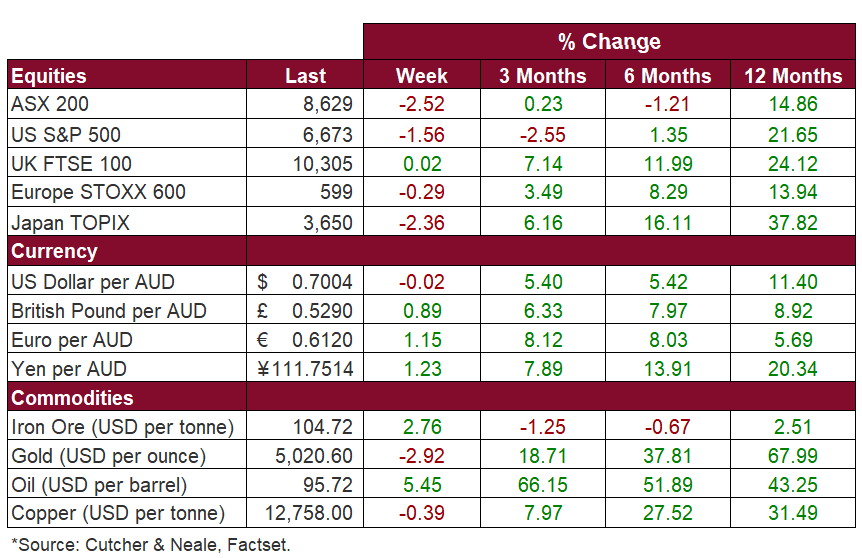
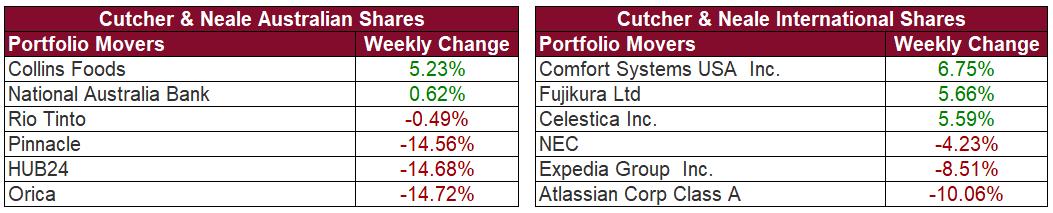
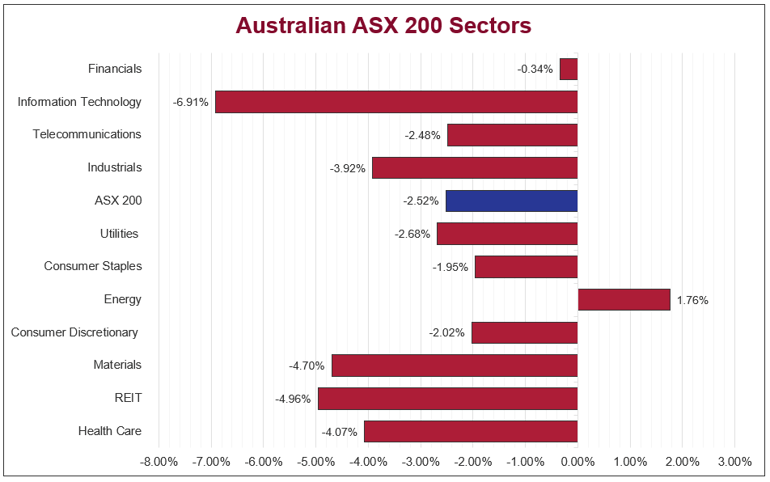
The Australian sharemarket fell sharply this week, with the ASX 200 down -2.5% as escalating Middle East geopolitical tensions rattled global markets. The Energy sector (+1.8%) provided a rare source of support, rising alongside crude oil amid heightened supply concerns, though higher energy costs added to inflation fears, pushing markets to price a 0.25% RBA rate hike this Tuesday. The Materials (-4.7%), REIT (-5.0%) and Information Technology (-6.9%) sectors underperformed amid trade disruptions and broad risk-off sentiment. Overall, geopolitical uncertainty and hawkish central bank expectations drove the broadest weekly decline since December.
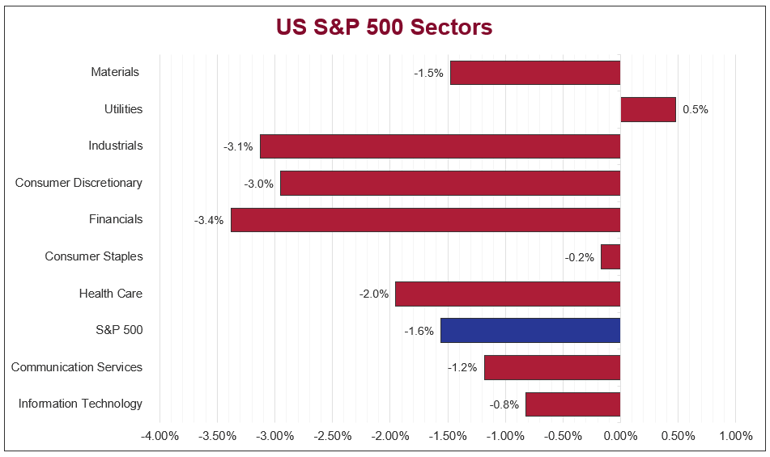
US sharemarkets hit a new low for the year last week, marking their third consecutive weekly loss, with the S&P 500 down -1.6% and the NASDAQ falling -1.3%, as escalating Middle East tensions and surging oil prices weighed on investor sentiment. The Financials (-3.4%) and Industrials (-3.1%) sectors led declines, reflecting weakness in banks, transports, and consumer-facing companies, while major technology stocks, including Meta Platforms (-4.8%) and Microsoft (-3.3%), pressured broader indices. The Energy (+2.2%) sector outperformed, bolstered by the spike in crude prices, partially offsetting broader market weakness.
European sharemarkets ended the week slightly lower, with the STOXX Europe 600 down -0.3%, amid volatility driven by soaring oil prices and the Iran conflict. Crude briefly surged above $120/bbl before settling near $100/bbl, as the International Energy Agency (IEA)’s release of a record 400M-barrel emergency reserve had little effect on easing price pressures. The Utilities (+3.7%) and Energy (+3.3%) sectors led gains, while the Construction & Materials (-2.7%) and Travel & Leisure (-2.5%) sectors were the worst performers, reflecting rising rate expectations and geopolitical uncertainty.
Stock & sector movements
What caught our eye
Australia’s Strongest Reporting Season in Years
The February reporting season in Australia has finished and the overall picture was clearer than the market noise suggested. Australian companies had one of their strongest earnings seasons in years, despite concerns around higher interest rates and inflation.
Breadth across sectors stood out. Banks reported stable margins and strong capital positions, miners benefitted from favourable commodity prices and several industrial companies showed meaningful profit margin expansion.
Strong results, volatile reactions
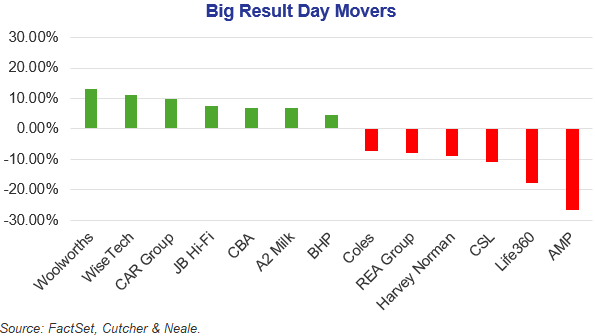
While the aggregate numbers look healthy, the market’s reaction to individual results were anything but calm. Many companies with solid numbers saw sharp single-day swings, with some rising or falling by more than 10%. This can be partly explained by algorithmic trader distortion, but also uncertainty felt by investors due to artificial intelligence and the potential for higher interest rates domestically.
Several blue-chip companies saw huge one-day moves on earnings announcements, something historically more common in small-cap stocks. For example, the market reacted sharply to bank and mining results, while other sectors experienced equally dramatic falls.
Retail highlights the divergence
Retail offers a good example of the divergence. Supermarket giant Coles delivered a respectable result, yet its shares fell 7.4% after investors focused on slower sales growth relative to rival Woolworths, which jumped 13.0% on its result.
Harvey Norman reported a 16.0% jump in profits but still saw its share price drop 9.0%, as investors worried about weakening consumer spending and the impact of higher interest rates. JB Hi-Fi was similar, reporting profit margin resilience but a slowdown in sales growth. Its share price initially fell 10.5%, before rallying through the day to close up 7.5%.
AI concerns weigh on tech
Technology stocks have been even more sensitive. Life360, for instance, initially rallied on strong results before reversing after analysts reduced price targets amid unresolved concerns that artificial intelligence could promote competition. This rhetoric was largely mirrored in WiseTech Global, Seek and CAR Group, as solid reports weren’t met with much enthusiasm. Or if they were, it was rather quickly abated.
What this means for investors
Some interesting points from the season were that the number of earnings beats outnumbered misses by 2:1 and guidance upgrades outpaced downgrades 3:1. Earnings forecasts for FY2026 were also revised sharply higher, rising from 3% six months ago to 13.6% now. Valuations do continue to look stretched, with the ASX 200’s forward price-to-earnings at 18.6x versus the long-run average of 14.9x, though the improved earnings quality seen in February makes it more palatable.
Three takeaways for us this earnings season in Australia:
-
Earnings momentum looks healthier heading into FY2026. Across banks, miners and industrials, the improvement wasn’t narrow, which matters for overall market stability.
-
Volatility created opportunities, not just risks. Sharp reactions to both beats and misses emphasise the importance of staying focused on fundamentals, rather than day-to-day share price moves.
-
Selectivity remains essential. Even with the strong season, results were varied and selection mattered more than usual.
The week ahead
Australian investors will watch Tuesday’s RBA rate decision, with a 0.25% hike to 4.10% widely expected amid elevated inflation and a tight labour market. Attention will also turn to Thursday’s employment figures for further guidance on economic momentum.
In the US, the Federal Reserve meets Wednesday, with markets expecting rates to remain on hold, though recent geopolitical risks and higher energy prices could influence future guidance.


Wade is the head of the Investment Services division at Cutcher & Neale and has over 15 years of industry experience in accounting and investment advisory roles.
Wade guides his division on the belief that investment portfolios should be built on transparency and flexibility. His expertise focuses on direct portfolio exposure to both Australian and Global Investment markets.
-1.png?width=352&name=Investment%20SnapShot%20Header%20-%20July%202025%20(1)-1.png)