
.png)
|
|
Quick TakeGlobal markets rebounded strongly in April: US equities led the recovery, with the S&P 500 rising 10.49%, the Nasdaq gaining 15.31%, and the Russell 2000 advancing 9.78%. European markets also moved higher, with the STOXX Europe 600 up 5.55%, while Australia’s ASX 200 rose 2.18%. Although geopolitical risks remained elevated, markets were supported by resilient earnings, firmer economic data and a recovery in risk appetite. The US led the recovery: Stronger earnings and renewed optimism toward artificial intelligence helped offset ongoing uncertainty from the Iran conflict. Oil prices remained volatile as negotiations stalled and concerns around the Strait of Hormuz persisted, but equity markets looked through much of the geopolitical noise. Economic data was also supportive, with employment improving, retail sales exceeding expectations and consumer confidence lifting. However, inflation remained a key risk, with bond yields rising and markets no longer expecting the Federal Reserve to cut interest rates this year. Europe and Australia also gained: European equities benefitted from improved investor flows and better-than-feared earnings, despite higher energy prices, rising bond yields and softer economic data. In Australia, expectations for another RBA rate rise increased as headline inflation lifted to 4.6% and trimmed mean inflation remained at 3.3%. Overall, April was a welcome recovery, but investors remain focused on whether higher energy prices and tighter financial conditions will weigh on growth. |
|
Snapshot
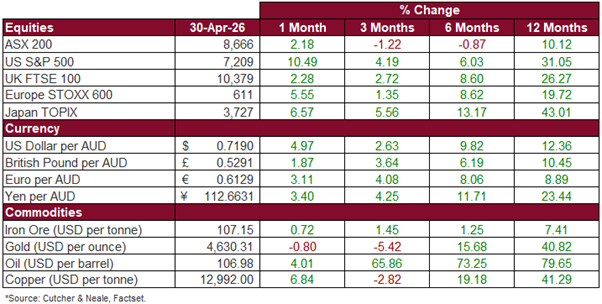 Global equity markets rebounded strongly in April, recovering some of the sharp losses recorded in March. In the US, the S&P 500 rose 10.49%, the Nasdaq gained 15.31%, and the Russell 2000 advanced 9.78%. European markets also moved higher, with the STOXX Europe 600 up 5.55%, the FTSE 100 rising 2.28%, the DAX gaining 7.11%, and the CAC increasing 4.44%. In Australia, the ASX 200 rose 2.18%. While markets remained sensitive to developments in the Middle East, investor sentiment improved as earnings results were generally resilient, economic data held up reasonably well, and risk appetite recovered after the volatility of the prior month.
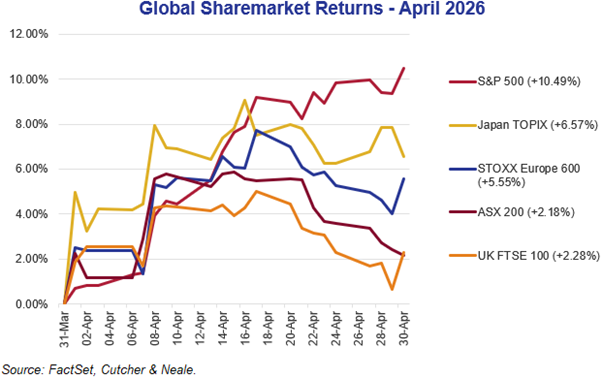
In the US, equity markets delivered a particularly strong month, with major indices reaching new highs despite ongoing geopolitical uncertainty. The conflict with Iran continued to generate significant headline risk, particularly around the Strait of Hormuz and the outlook for global energy supply. Oil prices remained volatile, with crude prices rising again late in the month as negotiations stalled and concerns around prolonged disruption increased. However, equity markets were supported by renewed optimism toward artificial intelligence, strong earnings results, and evidence that the economy remains resilient. Employment data improved from the prior month, retail sales were stronger than expected, and consumer confidence lifted. At the same time, inflation risks remained a key focus. Bond yields moved higher over the month and markets no longer expect the Federal Reserve to cut interest rates this year, reflecting the combination of firmer economic data, higher energy prices and a cautious central bank outlook.
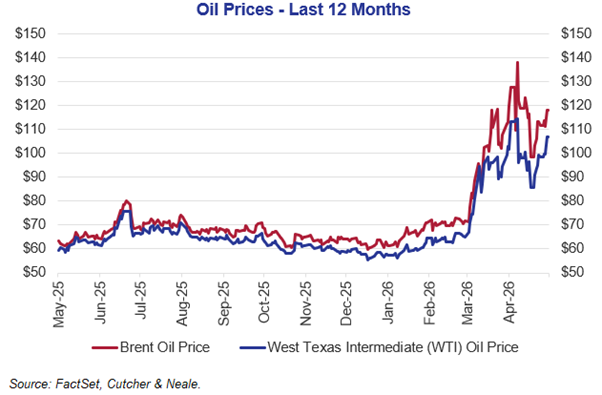
European markets also recovered in April, although the backdrop remained challenging. The region continued to be heavily influenced by energy market volatility and uncertainty surrounding the conflict in the Middle East. Early in the month, a fragile ceasefire and hopes for diplomatic progress supported a relief rally. However, sentiment became more cautious again as negotiations stalled and concerns over shipping disruptions and energy supply returned. Bond yields rose sharply, with the German 10-Year yield reaching its highest level since 2011, while UK yields also moved higher. Economic data remained soft, with business activity weakening, confidence measures deteriorating and Eurozone growth subdued. Inflation also rose, reinforcing concerns that policymakers may have limited room to ease monetary policy. Despite this, European equities benefitted from improved investor flows and better-than-feared corporate earnings, helping markets finish the month higher.
In Australia, the ASX 200 rose 2.18% in April, although the market gave back some of its earlier gains late in the month. Domestic investors remained focused on the Reserve Bank of Australia, with expectations building that another rate rise may be delivered at the May meeting. The RBA did not meet during April, but recent commentary reinforced the view that inflation remains too high and that policy may need to remain restrictive. Inflation data showed headline inflation rising to 4.6% over the year to March, largely driven by a sharp increase in fuel prices, while trimmed mean inflation remained at 3.3%. Labour market data also remained relatively firm, with the unemployment rate unchanged and full-time employment increasing. The Australian Dollar rose 4.97% to US$0.7190, while bond yields moved higher, with the 10-Year Government bond yield increasing to 5.02%.
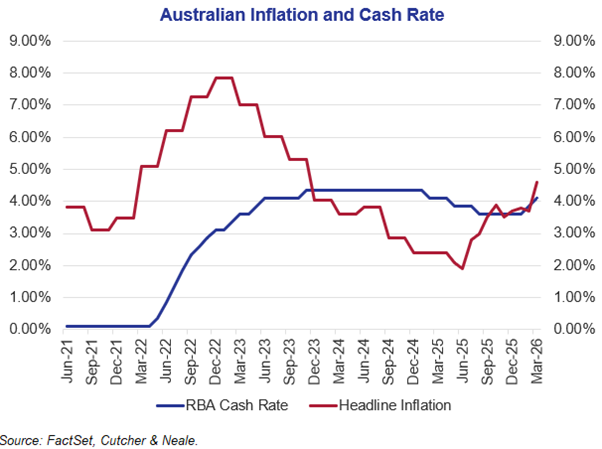
Overall, April provided a welcome recovery for global equity markets after a difficult March. While geopolitical risks, energy prices and inflation remain important sources of uncertainty, investors were encouraged by resilient economic data and stronger earnings momentum. The key issue from here is whether markets can continue to look through the geopolitical disruption, or whether higher energy prices and tighter financial conditions begin to weigh more meaningfully on growth.

Key Stocks



Ryan joined Cutcher & Neale as a Portfolio Manager in January 2023, bringing nearly 20 years of financial markets experience to the firm. Specialising in fundamental equity analysis and multi-asset strategies, Ryan holds the Chartered Financial Analyst (CFA) designation. He is responsible for the risk and return outcomes of the firm’s Managed Discretionary Account (MDA) portfolios on the Mason Stevens platform.

.png?width=352&name=Investment%20SnapShot%20Header%20-%202026%20(3).png)
.jpg?width=352&name=Investment%20SnapShot%20Header%20-%20March%202024%20(1).jpg)