
-1.png)
Weekly recap
What happened in markets
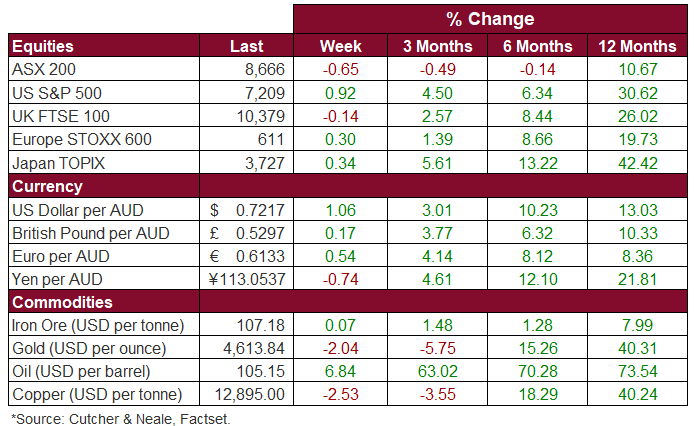
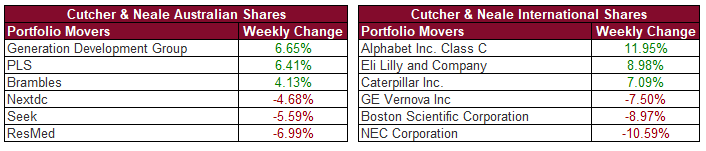
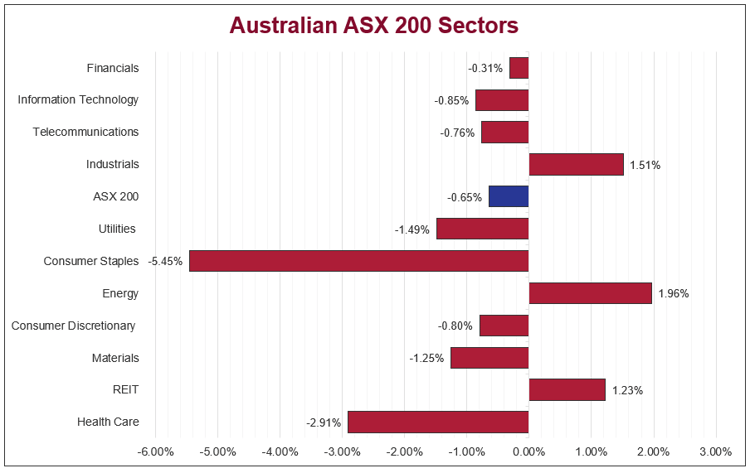
The Australian sharemarket finished another sluggish week, with the ASX 200 down 0.7%. Heightened volatility and geopolitical tensions continue to keep investors cautious along with the Reserve Bank meeting and Federal Budget looming. Market sentiment seems reluctant to shift until clarity is provided on Australia’s economic and financial trajectory. Defensive positioning unwound from the prior week, with the Consumer Staples sector declining 5.7%. Rising cost pressures linked to the oil market are impacting supermarket margins, with Woolworths Group’s (‑9.9%) quarterly update indicating margin compression and leading to earnings downgrades. The Health Care sector (-2.9%) also underperformed, large caps in the sector like CSL (-5.1%) and Resmed (-5.7%) continue to tread close to multi-year lows. Comparatively, the Energy sector (2.0%) posted solid gains supported by strong demand and tight supply. The Industrials sector (1.5%) and REIT sector (1.2%) were the only other two sectors in the green for the week.
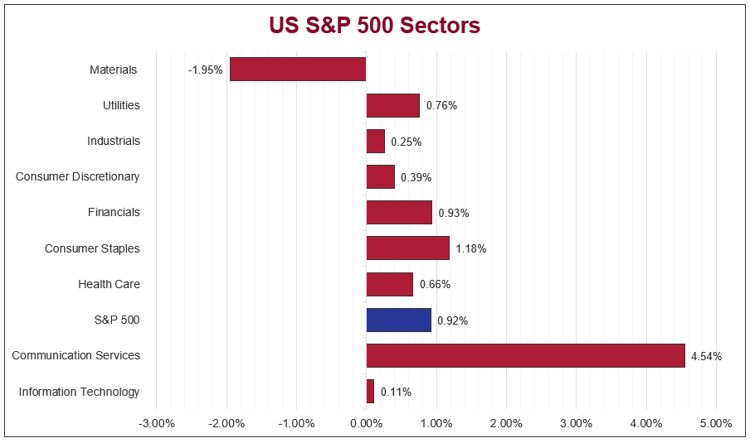
US sharemarkets inched higher over the week, with the S&P 500 finishing up 0.9%. Sentiment remains strong in AI-related names, while Q1 earnings growth also led to the S&P 500 and the NASDAQ reaching an all-time high. The Consumer Services sector (4.5%) rocketed higher largely due to Alphabet surging 12.0% on beating earnings expectations. The Energy sector (3.3%) posted solid gains with the macro backdrop continuing to support commodity producers. The Materials sector (-2.0%), was the only lagging sector in the S&P 500 for the week, as Newmont Mining (-10.0%) dragged the sector down due to profit taking and the recent drop in the price of Gold (2.0%). Consumer Staples (1.2%) and Financials sectors (0.9%) edged up, supporting growth in the US sharemarket.
European sharemarkets ended the week with small gains, with the STOXX Europe 600 ending the week up 0.3% as tensions in the Middle East continue to inadvertently effect European energy prices, weighing down risk sentiment. The Telecommunications sector (2.6%) was the leading outperformer for the week, while the Banking (1.8%) and Energy sectors (1.5%) supported the Euro markets small gains for the week. The Banking sector was supported by large cap banks like UBS (6.0%) and HSBC (2.9%) posting strong returns, along with the European Central Bank keeping rates on hold at 2.00%, supporting banking margins. The Retail sector (2.3%), Automotive sector (-2.0%) and Health Care (-1.1%) weighed on the market, driven by inflation, growth and higher rates for longer concerns.
Stock & sector movements
What caught our eye
What Caught Our Eye: Earnings season is holding up so far
We are now roughly a third of the way through the S&P 500 earnings season, and the early read has been positive. Companies are, in aggregate, still growing earnings and many are doing a better job than expected of managing costs and maintaining margins.
FactSet reports that 84% of companies to date have exceeded earnings forecasts, while 81% have surpassed revenue projections. The blended earnings growth rate for the quarter has also moved higher, from 13.1% at the end of March to 15.1%. If that holds, it will mark the sixth consecutive quarter of double-digit earnings growth.
That would be a solid result, particularly given the backdrop. Interest rates remain higher than they were a few years ago, consumers are becoming more selective, and businesses are still dealing with uncertainty around tariffs, supply chains and geopolitics.
The important caveat is that expectations are not low. The S&P 500 is trading on a forward price-to-earnings ratio of about 21x, which is above the 10-year average of 19x. In practical terms, that means investors are already assuming a fair bit of good news. Earnings do not just need to be okay, they need to be good enough to support the prices already being paid.
That brings us to the large technology companies, where much of the market’s attention has been focused. The key question is still whether the enormous investment in artificial intelligence is starting to translate into revenue growth, rather than just higher capital spending.
Alphabet’s (+12.0% over the week) result was encouraging on that front. Revenue grew 22%, while Google Cloud revenue rose 63% to US$20 billion. Management pointed to enterprise AI demand as a major driver of that growth. For investors, that was a useful sign that AI is beginning to show up in real customer spending.
Microsoft (-2.4%) also reported a strong quarter. Revenue increased 18% to US$83 billion, while Azure and other cloud services revenue grew 40%. The company continues to invest heavily in AI infrastructure, but the strength in cloud demand suggests that spending is being met by genuine customer take-up.
Meta’s (-9.8%) result was more complicated. The underlying advertising business remains healthy, and revenue came in ahead of expectations. However, investors focused on the company lifting its 2026 capital expenditure forecast to US$125-145 billion. It seemed investors weren’t too comfortable with another large investment cycle, as the stock price fell 9.4% in the subsequent trading session.
Payments processor Visa (+6.0%) was another notable reporter and one watched by many to get a read on consumers. The company’s net revenue rose 17% to US$11 billion, payments volume grew 9%, cross-border volume increased 12% and processed transactions were up 9%. These figures suggest that spending and travel activity remain reasonably healthy, despite cost-of-living pressures and a more cautious consumer environment.
For investors, the message from earnings season so far is steady strength, which is a comfort given the geopolitical uncertainty coming out of Iran. Corporate profits are still growing, the large technology companies are generally delivering, and the consumer has not rolled over. But with valuations elevated, selectivity matters. We continue to favour quality businesses with strong balance sheets and durable earnings.
The week ahead
In Australia, the main focus will be on the RBA interest rate decision with expectations of a 25bps rise to 4.35%, in addition to goods trade balance and building approvals data releases.
Overseas, attention will be on major US economic data releases including US jobless claims, ISM Services PMI, US unemployment rate and US non-farm payrolls, with results expected to provide indications of US economic health.


Wade is the head of the Investment Services division at Cutcher & Neale and has over 15 years of industry experience in accounting and investment advisory roles.
Wade guides his division on the belief that investment portfolios should be built on transparency and flexibility. His expertise focuses on direct portfolio exposure to both Australian and Global Investment markets.
-1.png?width=352&name=Investment%20SnapShot%20Header%20-%20July%202025%20(1)-1.png)