
Rising diesel prices are no longer a short‑term disruption, they are reshaping cost structures across Australia.
For many businesses, especially those reliant on freight, logistics, field services, construction materials, manufacturing, and distribution, supplier fuel levies are now standard practice rather than an exception. What makes this challenging is not just the cost increase itself, but the way it often flows quietly through invoices, variably applied and poorly understood.
In uncertain economic conditions, this has a direct and often underestimated impact on gross margin.
The organisations managing this pressure most effectively aren’t simply negotiating harder. They’re the ones taking a clear, data‑driven view of what these costs are really telling them.
How fuel levies affect your profit
Fuel levies are typically:
- Applied as variable percentages or per‑unit charges
- Inconsistent across suppliers
- Poorly separated from base cost pricing
- Passed through with limited transparency
Individually, they may appear immaterial. Collectively, they chip away at gross margin, often without being surfaced until month‑end or worse, quarter‑end.
Common symptoms we see include:
- Margin erosion that “doesn’t quite make sense”
- Jobs or product lines that are suddenly underperforming
- Increased revenue without a corresponding uplift in gross profit
- Pricing models that no longer reflect true cost‑to‑serve
In periods of rising fuel costs, not seeing this clearly is no longer a reporting problem, it’s a profitability risk. This is where Power BI becomes your decision-making tool.
Gross margin is where reality shows up first
When costs rise quickly, gross margin is the first place the truth reveals itself. Unlike overheads, fuel levies flow directly into cost of goods sold or cost of delivery, meaning:
- Margin compression happens immediately
- Recovery requires deliberate pricing or operational adjustments
- Delays in insight lead directly to lost profit
Without granular visibility, businesses are left asking: “Are margins falling because of fuel, pricing, supplier behaviour, or operational inefficiency?”
Power BI is designed to answer that question.
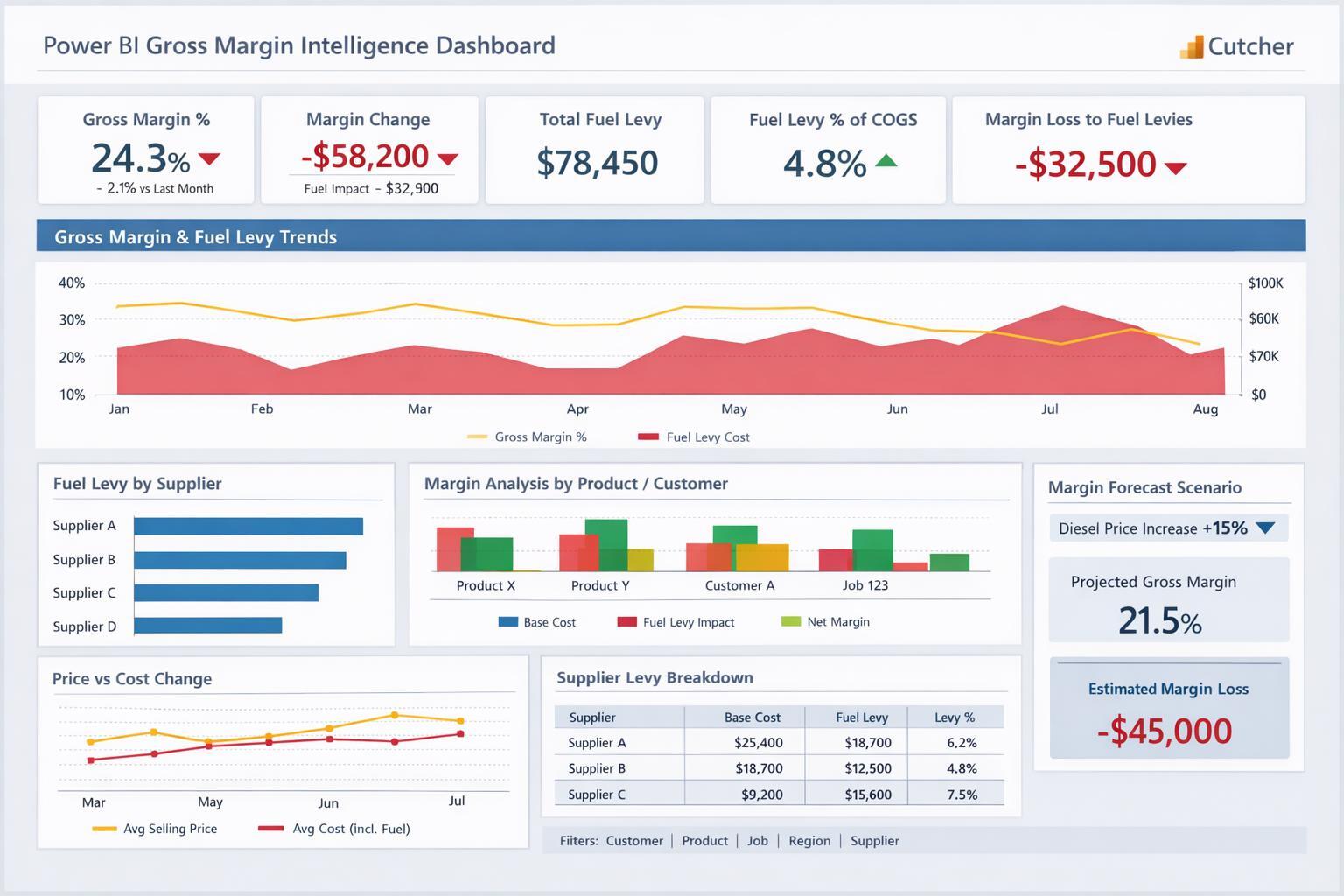
Power BI: Turning cost pressure into clarity
Power BI is a reporting tool that helps businesses understand their gross margin and why it is changing.
By integrating supplier data, purchasing records, invoice detail, sales pricing and operational volumes, Power BI allows organisations to isolate the true impact of fuel levies on profitability.
This matters now more than ever.
How Power BI helps protect gross margin in a fuel‑driven cost environment
1. Separate fuel levies from base supplier costs
In many systems, fuel levies are buried inside cost lines.
Power BI enables businesses to:
-
- Isolate fuel levy components
- Track them separately from base supplier pricing
- Analyse trends over time and by supplier
This visibility answers a critical question: “Is our supplier actually increasing prices or is diesel the culprit?”
That distinction drives very different commercial responses.
2. Identify margin leakage by product, job or customer
Fuel costs don’t affect all revenue equally.
Power BI allows gross margin to be analysed by:
-
- Product or SKU
- Job or project
- Customer or contract
- Geographic delivery zone
- Supplier or freight route
This highlights where fuel levies are:
-
- Being absorbed instead of passed on
- Eroding margin disproportionately
- Turning once‑profitable work into loss‑making activity
Without this level of insight, profitability decisions are made blindly.
3. Compare price increases to cost increases in real time
One of the biggest risks during cost escalation is price lag.
Power BI enables:
-
- Side‑by‑side analysis of revenue pricing vs supplier cost changes
- Early identification of margin gaps
- Data‑backed justification for price adjustments or levy pass‑throughs
This moves pricing conversations from reactive to proactive, internally and with customers.
4. Support evidence‑based supplier negotiations
Supplier conversations change dramatically when you have data.
Power BI provides:
-
- Clear visibility into how fuel levies impact total supplier cost
- Benchmarking across multiple suppliers
- Fact‑based insight into cost volatility vs consistency
Instead of vague disputes, discussions become grounded in evidence, increasing leverage in renegotiation.
5. Improve forecasting and scenario planning
Fuel costs are volatile by nature.
With Power BI, businesses can:
-
- Model “what‑if” scenarios around diesel price movements
- Forecast gross margin under different levy assumptions
- Stress‑test budgets before cost increases hit the P&L
This transforms fuel levies from a surprise into a planned variable.
From reporting to margin intelligence
Traditional reporting tends to ask: “What happened?”
Power BI asks: “What is happening and what will happen if this continues?”
That shift is especially powerful when managing gross margin in a cost‑inflation environment. Instead of discovering margin loss after the fact, leaders gain:
-
- Early warning signals
- Continuous visibility into profitability drivers
- Confidence to act decisively
Power BI works with your existing systems
Importantly, Power BI does not require replacing finance or operational platforms.
It integrates seamlessly with:
-
- ERP and accounting systems
- Purchasing and inventory platforms
- Job costing and project systems
- Supplier invoices and data extracts
The team at Cutcher & Neale Business Systems has extensive experience building date flows to SQL, joining data from multiple systems, gateway connections and direct connection to Power BI.
This allows rapid uplift in insight without operational disruption which is a key advantage in uncertain times.
Insight is the only sustainable margin defence
Rising diesel prices and supplier fuel levies are now a structural reality for many industries.
Businesses that rely on high‑volume, low‑margin models are particularly exposed and those without granular visibility into gross margin feel the pain first and longest.
Power BI does not remove cost pressure. It ensures you can see it, understand it, and respond before it erodes profitability.
Turning margin pressure into clarity
At Cutcher & Neale, we help organisations design Power BI reporting solutions that focus on what matters most: gross margin, cost drivers, and commercial decision‑making.
When supplier fuel levies become the norm, insight is no longer optional.
Understanding what your data is telling you may be the difference between absorbing margin loss and protecting profitability.
If you'd like to learn more, feel free to reach out to the team.

Michael Graham is a Partner specialising in business systems, operational workflows, and cost accounting. Direct, honest, and analytical, he helps clients optimise their systems, improve operational efficiency, and make informed financial and strategic decisions across diverse industries.