|
|
Quick TakeGlobal volatility amid shifting rate expectations: Global equity markets were mixed in November as investors weighed sticky inflation, evolving interest rate expectations and ongoing geopolitical risks. The S&P 500 rose 0.25%, the Dow gained 0.48%, while the Nasdaq fell 1.45% and the Russell 2000 added 0.96%. US markets swung sharply during the month before recovering into month-end, helped by a late shift towards a high probability of a December Federal Reserve rate cut. US bond yields eased, with the 2-year falling to 3.50% and the 10-year to 4.03%, while gold continued its strong run. Europe steadies on earnings resilience and policy clarity: In Europe, the STOXX Europe 600 rose 0.98%, with several major indices remaining near record highs. Sentiment improved as inflation stayed benign, Q3 earnings beat expectations and forward profit forecasts were revised higher. Central banks largely held policy steady, while softer UK inflation at 3.6% and weaker labour data saw markets price in a greater likelihood of Bank of England rate cuts. French political and budget uncertainty persisted but did not derail the broader improvement in the regional outlook. Australia lags as sticky inflation restrains optimism: In Australia, the ASX 200 fell 2.66%, its weakest month since March, as cautious earnings updates and offshore leads weighed on sentiment. The Reserve Bank left the cash rate at 3.60% but flagged lingering inflation pressures, reinforced by stronger employment data and a hotter monthly CPI print. Bond yields moved higher across the curve, while the Australian dollar was broadly steady, rising 0.18% to US$0.6558. |
|
Snapshot
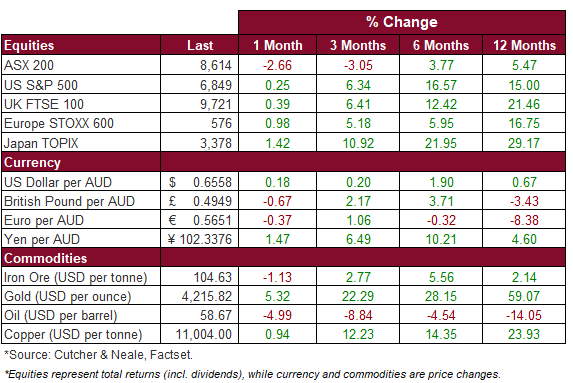
Global equity markets were mixed in November as investors navigated shifting interest rate expectations, ongoing geopolitical uncertainty, and a series of volatile moves across major benchmarks. While the month began with renewed concerns around sticky inflation and the possibility of delayed monetary easing, sentiment improved late in the period as central bank commentary turned more supportive. Government bond yields declined across several regions, the US dollar softened slightly, and gold extended its strong year-to-date run. Oil prices continued to drift lower, reflecting both supply dynamics and early signs of progress in geopolitical negotiations.
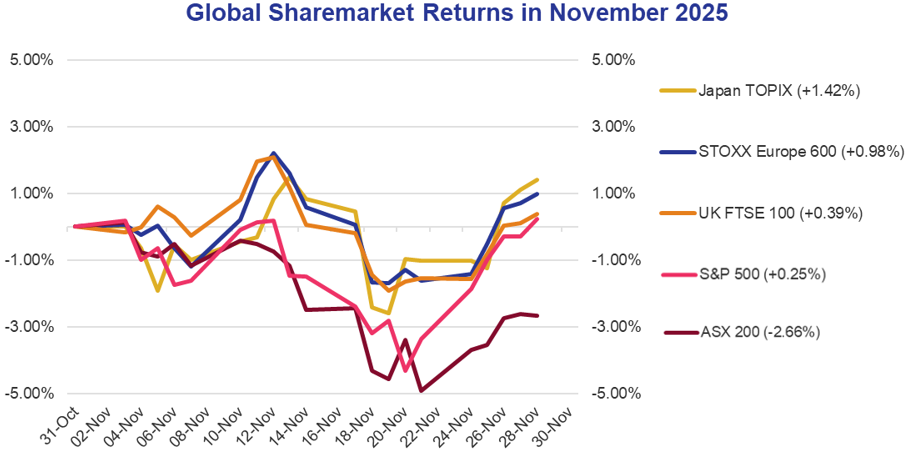
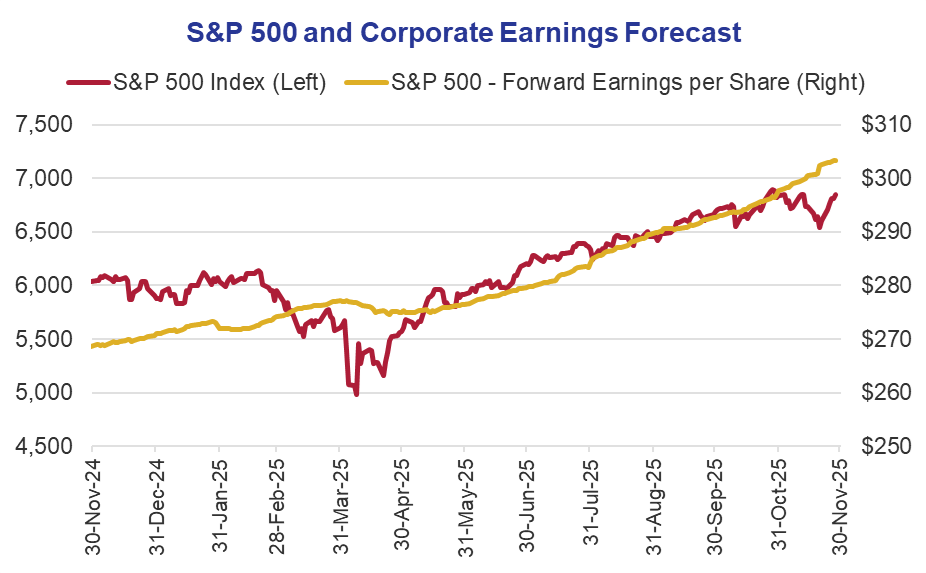
In the United States, equities delivered a subdued but positive performance overall. The S&P 500 rose 0.25%, the Dow gained 0.48%, while the Nasdaq fell 1.45%, snapping its multi-month winning streak. The Russell 2000 added 0.96% as smaller companies enjoyed a modest rebound. Markets were volatile throughout the month, with the S&P 500 having been down more than 4.5% at one point before recovering into month-end. A key driver of sentiment was the evolving outlook for interest rates. Early in November, several Federal Reserve officials emphasised caution around near-term easing, which pushed expectations for a December rate cut below 30%. However, more dovish comments late in the month reversed much of that shift, with markets assigning a high probability to a December reduction by month-end. Bond yields declined accordingly, with the US 2-year falling to 3.50% and the 10-year easing to 4.03%. The broader economic backdrop remained resilient, supported by firm GDP estimates and solid corporate earnings trends.
European equities also ended the month mixed, with the STOXX Europe 600 up 0.98%. Several major indices remained near record highs, helped by improving macro visibility, benign inflation data, and stronger-than-expected Q3 earnings results across the region. Corporate sentiment continued to recover, with forward earnings expectations broadly revised higher. Central banks largely remained on hold, though markets increasingly priced the potential for Bank of England rate cuts as UK inflation eased to 3.6% and labour-market conditions softened. Fiscal policy developments also drew attention, particularly the UK Budget, which added to the government’s fiscal buffer through a series of tax measures. Meanwhile, France continued to experience elevated political and budget uncertainty, which contributed to a cautious tone among investors. Despite this, Europe’s overall economic outlook improved, underscored by ongoing expansion in private-sector activity and clearer policy settings heading into 2026.
In Australia, the ASX 200 declined 2.66% in November, marking its weakest monthly performance since March. Market sentiment was weighed down by cautious earnings updates, unfavourable offshore leads, and renewed concerns around the domestic inflation outlook. The Reserve Bank left the cash rate unchanged at 3.60% but noted signs that inflationary pressures may persist for longer than expected. Stronger-than-anticipated employment data and a hotter monthly CPI reading reinforced expectations that the RBA may stay on hold for an extended period. Bond yields moved higher across the curve, while the Australian dollar was little changed, rising 0.18% to US$0.6558.
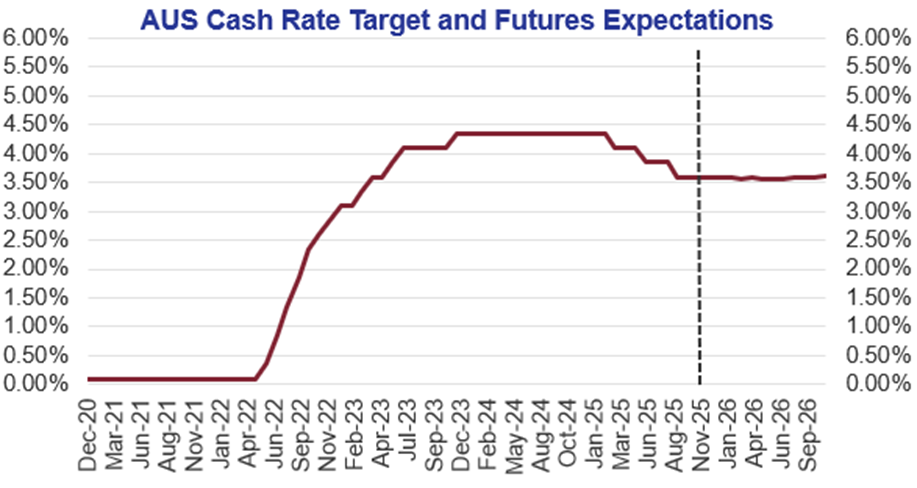
Overall, November was defined by volatility but not a material change in the global economic narrative. While policy uncertainty remains, easing inflation in key regions, resilient macro conditions, and supportive corporate earnings trends helped markets stabilise into month-end. The focus now shifts to December’s central bank meetings and year-end economic data, which will provide important signals for the interest rate outlook and the market environment as we head into 2026.

Key Stocks

Sumitomo Mitsui Financial Group
Cutcher & Neale International Shares
Sumitomo Mitsui Financial Group (SMFG) is Japan’s second-largest bank by market cap and a leader in consumer finance, credit cards and aviation leasing. What sets it apart is a quiet but deliberate transformation that’s gathering momentum both in Japan and across Asia.
SMFG’s earnings are riding a tailwind of rising domestic interest rates, higher margins and lower credit costs. For the six months to September 2025, the bank reported ¥934 billion in net income, up 29% on the prior year. Management upgraded full-year guidance and lifted dividends, reflecting confidence in the earnings outlook and capital position.
What we like about SMFG is that the group is increasingly positioning itself as a Asian banking powerhouse. Its overseas loans now represent 41% of its total book, with strategic equity stakes in banks across Vietnam, the Philippines, Cambodia and India, including a recent 20% equity investment in Yes Bank. The firm also announced a deeper global alliance with US-based bank Jefferies to jointly scale cross-border investment banking in the US and Europe.
Return on equity is projected to rise to ~10.5% in FY26, driven by scale benefits, cost discipline and asset reallocation. Management is also accelerating the sale of legacy equity holdings, freeing up capital for growth or buybacks ahead of tighter Basel III rules.
Trading at ~1.1x book with a 3% dividend yield, SMFG offers exposure to a still-underappreciated structural growth story in Asian banking, with solid capital returns and a growing global footprint.
Siemens Energy
Cutcher & Neale International Shares Model
Cutcher & Neale Positive Impact Model
Siemens Energy is fast becoming a key infrastructure enabler of the global energy transition and a clear beneficiary of the artificial intelligence boom.
The company manufactures gas turbines, power grid hardware and wind turbines. These technologies support decarbonisation, grid modernisation and the growing electricity load from data centres. Its earnings upgrade in November 2025 confirmed this structural demand, with 2028 profit margin guidance lifted to 14-16% (up from 10-12%), powered by surging orders and a record order backlog of $138 billion.
Siemens holds a 25% global market share in gas turbines, second only to GE Vernova (another holding in the Cutcher & Neale International Shares and Positive Impact Models). AI data centre growth and coal-to-gas switching are reinvigorating demand, with orders for gas services jumping 43% in 2025 alone.
Siemens Energy is also a top-tier supplier of high-voltage grid solutions used to integrate renewables and reinforce aging electricity networks. Orders for this division rose strongly in 2025, supported by growing investment in HVDC (high-voltage direct current) systems.
Admittedly, Siemens Energy is trading at a premium compared to history. However, we believe this higher valuation is justified, with recent megatrends representing a new regime for the company. The market seems to agree, with Siemens expected to grow earnings by more than 30% per annum over the next three years.
Sumitomo Mitsui Financial Group
Cutcher & Neale International Shares
Sumitomo Mitsui Financial Group (SMFG) is Japan’s second-largest bank by market cap and a leader in consumer finance, credit cards and aviation leasing. What sets it apart is a quiet but deliberate transformation that’s gathering momentum both in Japan and across Asia.
SMFG’s earnings are riding a tailwind of rising domestic interest rates, higher margins and lower credit costs. For the six months to September 2025, the bank reported ¥934 billion in net income, up 29% on the prior year. Management upgraded full-year guidance and lifted dividends, reflecting confidence in the earnings outlook and capital position.
What we like about SMFG is that the group is increasingly positioning itself as a Asian banking powerhouse. Its overseas loans now represent 41% of its total book, with strategic equity stakes in banks across Vietnam, the Philippines, Cambodia and India, including a recent 20% equity investment in Yes Bank. The firm also announced a deeper global alliance with US-based bank Jefferies to jointly scale cross-border investment banking in the US and Europe.
Return on equity is projected to rise to ~10.5% in FY26, driven by scale benefits, cost discipline and asset reallocation. Management is also accelerating the sale of legacy equity holdings, freeing up capital for growth or buybacks ahead of tighter Basel III rules.
Trading at ~1.1x book with a 3% dividend yield, SMFG offers exposure to a still-underappreciated structural growth story in Asian banking, with solid capital returns and a growing global footprint.
Siemens Energy
Cutcher & Neale International Shares Model
Cutcher & Neale Positive Impact Model
Siemens Energy is fast becoming a key infrastructure enabler of the global energy transition and a clear beneficiary of the artificial intelligence boom.
The company manufactures gas turbines, power grid hardware and wind turbines. These technologies support decarbonisation, grid modernisation and the growing electricity load from data centres. Its earnings upgrade in November 2025 confirmed this structural demand, with 2028 profit margin guidance lifted to 14-16% (up from 10-12%), powered by surging orders and a record order backlog of $138 billion.
Siemens holds a 25% global market share in gas turbines, second only to GE Vernova (another holding in the Cutcher & Neale International Shares and Positive Impact Models). AI data centre growth and coal-to-gas switching are reinvigorating demand, with orders for gas services jumping 43% in 2025 alone.
Siemens Energy is also a top-tier supplier of high-voltage grid solutions used to integrate renewables and reinforce aging electricity networks. Orders for this division rose strongly in 2025, supported by growing investment in HVDC (high-voltage direct current) systems.
Admittedly, Siemens Energy is trading at a premium compared to history. However, we believe this higher valuation is justified, with recent megatrends representing a new regime for the company. The market seems to agree, with Siemens expected to grow earnings by more than 30% per annum over the next three years.
Ryan joined Cutcher & Neale as a Portfolio Manager in January 2023, with over 15 years' experience managing multi-asset investment portfolios, specialising in fundamental equity analysis. Ryan holds the Chartered Financial Analyst (CFA) designation and is Chairperson of the Cutcher & Neale Investment Committee, which oversees clients' Australian Share, International Share, Fixed Income and Cash exposures.
Ready for Next-Level Automation? See What’s New in Ostendo 243
Thinking ahead, acting today: Must-know succession strategies for practice owners
From locum shifts to running your own practice: When your cover needs an upgrade
The million-dollar question: How much super do doctors really need to retire comfortably?
Start the new year right: Why smart tax planning begins now and not in June