Skip to content

Early Momentum - February 2026 Snapshot

Written by
Ryan Thompson
Published on
03 February 2026
Updated on
03 February 2026
Time to read
minutes


Table of contents


Quick Take

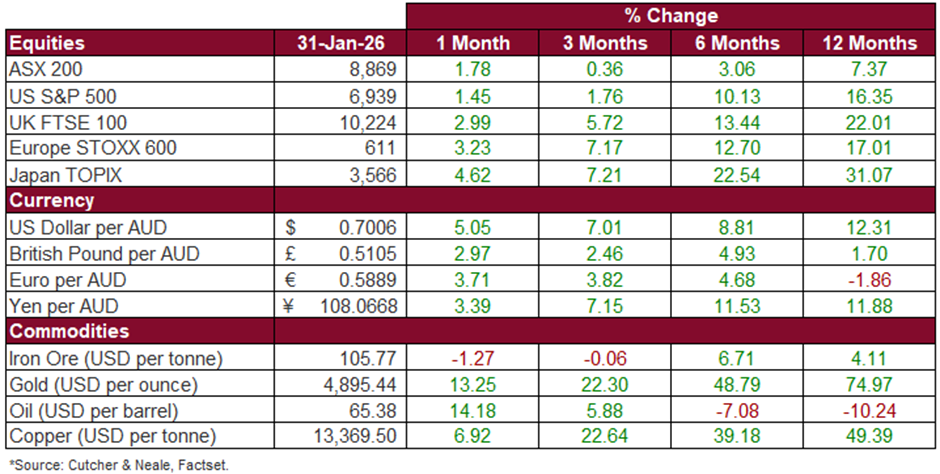
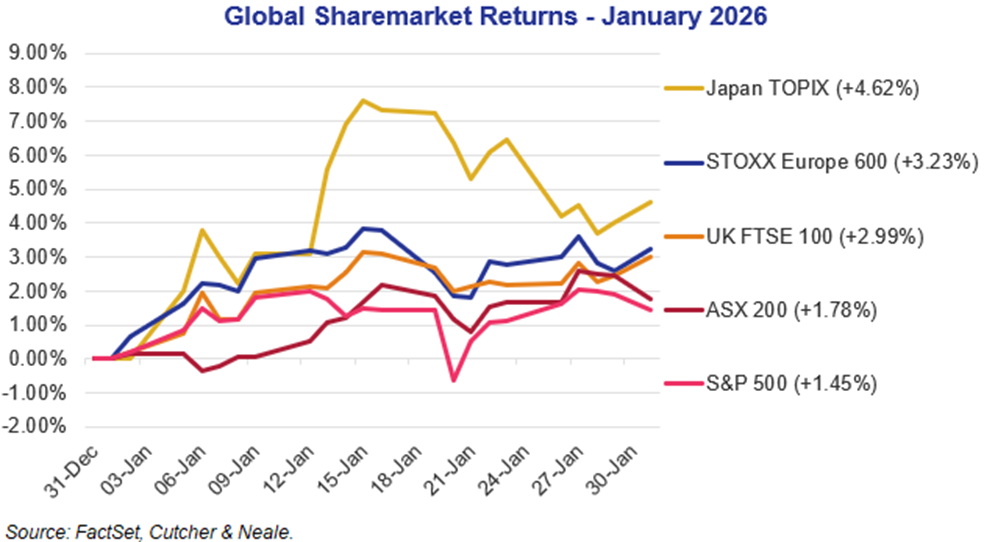
Global markets started 2026 on a firmer footing: Most major sharemarkets rose in January despite elevated geopolitical noise and continued debate about the interest rate outlook. Investors largely looked through volatility in policy headlines and commodities, even as bond yields edged higher in several regions and the US dollar weakened against most major currencies. Energy and precious metals were standout movers, supported by a mix of supply concerns and safe haven demand.

US equities posted a constructive month as leadership broadened: The S&P 500 gained 1.45%and the Nasdaq rose 0.97%, ending two straight monthly declines, while the Russell 2000 surged 5.35% in its strongest month since August. Markets rotated away from more concentrated leadership towards more economically sensitive exposures. The Federal Reserve held interest rates steady and maintained a patient stance, with markets still pricing some easing later in 2026, though expectations softened compared with the start of the month.

Europe and Australia were supported by improving momentum but watched inflation closely: The STOXX Europe 600 rose 3.23% to fresh all-time highs on better macro data, stabilising inflation and generally constructive earnings, despite ongoing political and trade uncertainty. In Australia, the ASX 200 gained 1.78% as commodities and a weaker US dollar provided support, while the labour market surprised to the upside with unemployment falling to 4.1%. Inflation remained elevated with headline CPI at 3.8%, lifting expectations for tighter domestic policy, alongside a stronger Australian dollar, up 5.05% to around US$0.7006.


Snapshot

Global equity markets began 2026 on a firmer footing, with most major sharemarkets posting gains in January despite heightened geopolitical uncertainty and ongoing debate around the outlook for interest rates. Risk appetite proved resilient as investors looked through sharp swings in commodities, renewed political tensions, and volatile policy headlines. Bond yields edged higher in several regions, while the US dollar weakened against most major currencies over the month. Commodity markets were particularly active, with strong gains in energy and precious metals reflecting both supply concerns and safe haven demand.
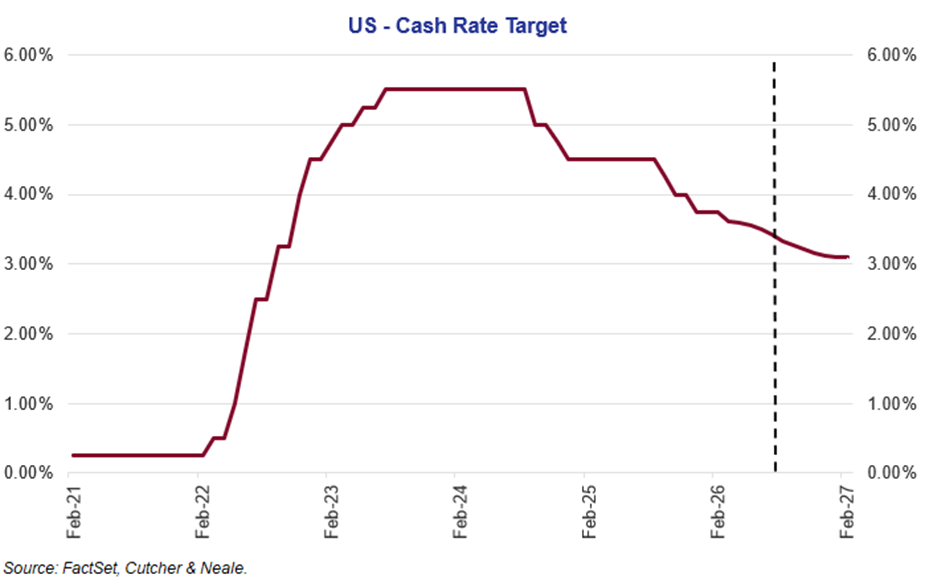
In the United States, equity markets delivered a solid start to the year. The S&P 500 rose 1.45% and the Nasdaq advanced 0.97%, ending two consecutive monthly declines. Smaller companies significantly outperformed, with the Russell 2000 surging 5.35% and recording its strongest monthly result since August. Market leadership broadened during the month as investors rotated away from concentrated areas of the market and toward more economically sensitive exposures. The Federal Reserve left interest rates unchanged at its January meeting, as expected, and reiterated a patient approach to future policy decisions. While markets continue to price some easing later in the year, expectations moderated modestly, with rate cut pricing reduced compared with the start of the month. Economic data remained mixed but generally supportive, with labour market indicators pointing to continued resilience, even as consumer confidence softened.
European equities extended their strong momentum into the new year. The STOXX Europe 600 rose 3.23% in January and reached fresh all-time highs, supported by improving macroeconomic data, stabilising inflation trends, and generally constructive earnings updates. Investor sentiment was buoyed by Europe’s valuation appeal relative to the United States, as well as signs of gradual economic recovery across several key economies. Geopolitical developments generated periodic volatility, particularly early in the month, but markets stabilised as tensions eased. Central banks across the region largely remained on hold, with policymakers signalling a cautious but flexible stance as inflation continues to moderate. Political developments in France and ongoing uncertainty surrounding trade relations with the United States remained in focus, though these issues did not materially derail broader market performance.

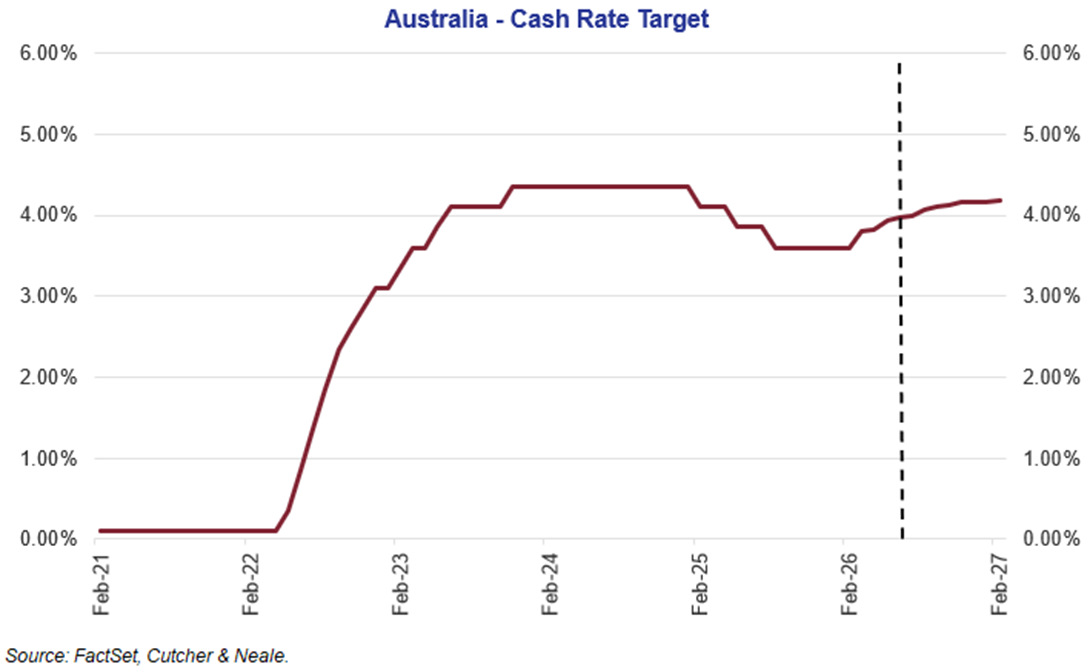
In Australia, the ASX 200 gained 1.78% in January, building on December’s recovery and moving closer to its previous record highs. The market was supported by stronger commodity prices and a weaker US dollar, while sector leadership rotated noticeably during the month. Domestic economic data surprised to the upside, particularly in the labour market, with employment growth stronger than expected and the unemployment rate falling to 4.1%. Inflation data also remained elevated, with headline CPI rising to 3.8% and underlying measures staying above the Reserve Bank’s target range. As a result, interest rate expectations shifted higher, with markets increasingly pricing the risk of further tightening. Bond yields rose modestly across the curve, while the Australian dollar strengthened 5.05% to end the month near US$0.7006.
Overall, January marked a constructive start to 2026 for global markets, characterised by broadening equity participation, resilient economic conditions, and ongoing volatility driven by geopolitics and monetary policy uncertainty. While inflation and interest rates remain key risks, improving growth momentum and stabilising policy expectations have helped underpin investor confidence as the year gets underway.

Contact us today!


Key Stocks

Sonic logo

Sonic Healthcare

Cutcher & Neale Australian Shares Model

Sonic Healthcare is a leading global pathology provider with a dominant presence in Australia, Europe and selective US regions. The company operates under a hub-and-spoke model, enabling cost efficiencies and scalable growth across its testing infrastructure.

The group recently reaffirmed its FY26 earnings guidance, expecting 8% growth, supported by solid organic revenue momentum of 5% year-to-date. Management also flagged easing cost pressures, including lower rental and interest expenses.

What we like about Sonic is its ability to leverage scale for durable cost advantages. It is the largest private pathology operator in Australia, Germany, Switzerland and the UK, with meaningful share gains in fragmented US markets via bolt-on acquisitions and joint ventures. This scale enables Sonic to run higher volumes through existing labs, supporting margin improvement over time.

Sonic’s balance sheet is in solid shape, with net debt/EBITDA at 2.0x and strong free cash flow conversion enabling a high dividend payout ratio. The group’s base pathology business is expected to grow at 5% p.a. over the next decade, with diagnostic imaging growing slightly faster. We expect its return on invested capital to be around 11% p.a. in the coming years, well above our estimated 7% cost of capital.

The Investment Committee added Sonic Healthcare to the Cutcher & Neale Australian Shares Model during the December quarter.


Chubb logo

Chubb

Cutcher & Neale International Shares Model

Chubb is a global property and casualty insurance leader, offering tailored solutions across commercial, personal and specialty lines, with operations spanning over 50 countries.

The company continues to benefit from multiple industry tailwinds, including firm pricing trends and lower catastrophe losses. In the September quarter, Chubb reported an impressive adjusted tangible return on equity of 25%, supported by a 5% rise in P&C net written premiums and a drop in catastrophe losses to US$285 million, from US$765 million a year earlier. Notably, underwriting margins improved in personal lines, driving the underlying combined cost ratio down to 82.5%, among the best in the industry.

What we like about Chubb is its disciplined underwriting and leading positions in the most resilient segments of global insurance. The group’s international footprint and strong brand make it one of the few insurers capable of servicing complex, multinational clients. Its high-net-worth personal lines business is also uniquely positioned, offering insurance on fine art, yachts and global property, segments that demand scale and precision.

The Investment Committee added Chubb Ltd to the Cutcher & Neale International Shares Model during the December quarter.


Sonic logo

Sonic Healthcare

Cutcher & Neale Australian Shares Model

Sonic Healthcare is a leading global pathology provider with a dominant presence in Australia, Europe and selective US regions. The company operates under a hub-and-spoke model, enabling cost efficiencies and scalable growth across its testing infrastructure.

The group recently reaffirmed its FY26 earnings guidance, expecting 8% growth, supported by solid organic revenue momentum of 5% year-to-date. Management also flagged easing cost pressures, including lower rental and interest expenses.

What we like about Sonic is its ability to leverage scale for durable cost advantages. It is the largest private pathology operator in Australia, Germany, Switzerland and the UK, with meaningful share gains in fragmented US markets via bolt-on acquisitions and joint ventures. This scale enables Sonic to run higher volumes through existing labs, supporting margin improvement over time.

Sonic’s balance sheet is in solid shape, with net debt/EBITDA at 2.0x and strong free cash flow conversion enabling a high dividend payout ratio. The group’s base pathology business is expected to grow at 5% p.a. over the next decade, with diagnostic imaging growing slightly faster. We expect its return on invested capital to be around 11% p.a. in the coming years, well above our estimated 7% cost of capital.

The Investment Committee added Sonic Healthcare to the Cutcher & Neale Australian Shares Model during the December quarter.


Chubb logo

Chubb

Cutcher & Neale International Shares Model

Chubb is a global property and casualty insurance leader, offering tailored solutions across commercial, personal and specialty lines, with operations spanning over 50 countries.

The company continues to benefit from multiple industry tailwinds, including firm pricing trends and lower catastrophe losses. In the September quarter, Chubb reported an impressive adjusted tangible return on equity of 25%, supported by a 5% rise in P&C net written premiums and a drop in catastrophe losses to US$285 million, from US$765 million a year earlier. Notably, underwriting margins improved in personal lines, driving the underlying combined cost ratio down to 82.5%, among the best in the industry.

What we like about Chubb is its disciplined underwriting and leading positions in the most resilient segments of global insurance. The group’s international footprint and strong brand make it one of the few insurers capable of servicing complex, multinational clients. Its high-net-worth personal lines business is also uniquely positioned, offering insurance on fine art, yachts and global property, segments that demand scale and precision.

The Investment Committee added Chubb Ltd to the Cutcher & Neale International Shares Model during the December quarter.


About The Author
Ryan joined Cutcher & Neale as a Portfolio Manager in January 2023, bringing nearly 20 years of financial markets experience to the firm. Specialising in fundamental equity analysis and multi-asset strategies, Ryan holds the Chartered Financial Analyst (CFA) designation. He is responsible for the risk and return outcomes of the firm’s Managed Discretionary Account (MDA) portfolios on the Mason Stevens platform.

Ready to take the next step? We’re here to help you move forward with comfort and clarity.

Contact