
-1.png)
Weekly recap
What happened in markets
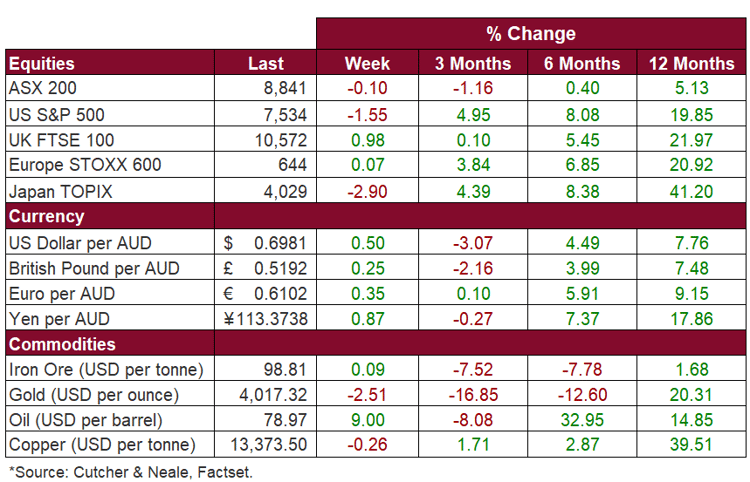
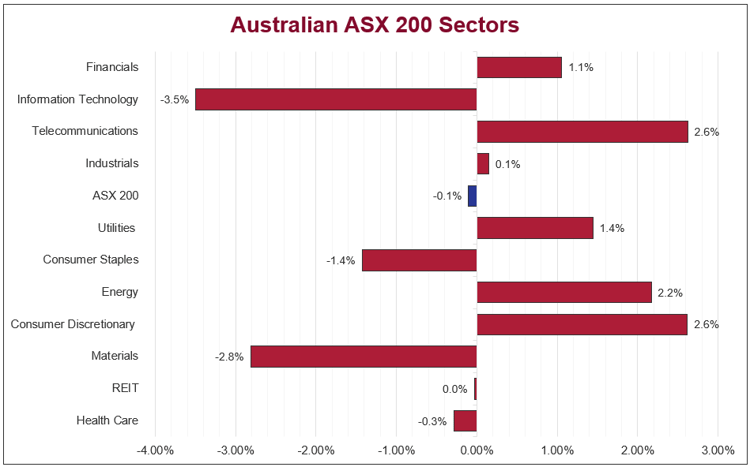
The Australian sharemarket was modestly lower over the week, with the ASX 200 declining -0.1% as losses in materials stocks offset strength elsewhere in the market. The Financials sector (+1.1%) outperformed, supported by gains across the major banks and AMP, which surged after upgrading earnings guidance. The Energy sector (+2.2%) also finished higher as investors monitored ongoing geopolitical tensions in the Middle East and their potential implications for oil supply. However, the Materials sector (-2.8%) weighed heavily on the index following weakness in gold producers and broader commodity-related stocks. Markets also digested mixed Chinese economic data and Australian spending indicators, contributing to a cautious trading backdrop.
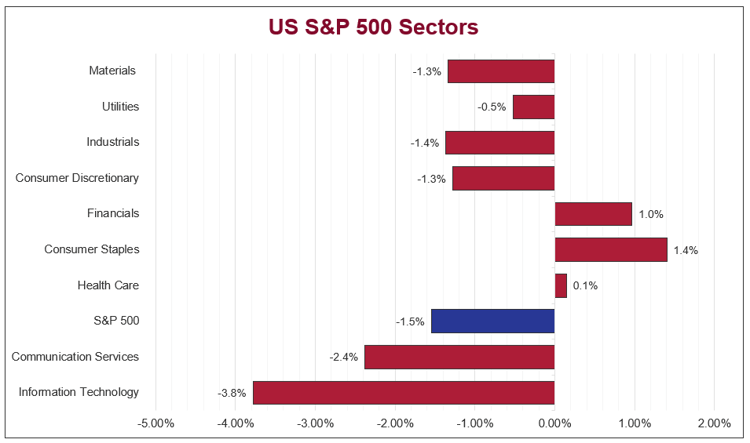
US sharemarkets were lower over the week, with the S&P 500 falling -1.5% and the NASDAQ declining -2.9%, as investors rotated away from momentum and AI-related stocks. Weakness was concentrated in the Information Technology sector (-3.8%) and Communication Services sector (-2.4%), driven by a sharp sell-off in semiconductor, memory and AI infrastructure companies amid concerns around increasing competition from Chinese AI models and a potential slowdown in hyperscaler spending. Offsetting some of the weakness, the Energy sector (+5.0%) outperformed as escalating US-Iran tensions pushed oil prices higher. Softer-than-expected inflation data provided some support, although geopolitical uncertainty and AI-related concerns remained key market themes.
European sharemarkets were little changed over the week, with the STOXX Europe 600 rising 0.1%, as improving earnings expectations and easing inflation pressures were balanced by renewed geopolitical tensions and weakness in technology stocks. The Energy sector (+1.3%) was the strongest performer, supported by higher oil prices amid escalating US-Iran tensions, with BP (+6.9%) and Shell (+6.2%) among the key contributors. In contrast, the Technology sector (-3.3%) underperformed as concerns emerged around AI-related spending following the launch of China's low-cost Kimi K3 model, prompting a global semiconductor sell-off. The Basic Resources sector (-1.4%) also weakened as softer copper prices weighed on mining stocks.
Stock & sector movements

What caught our eye
The Pay Squeeze Doing the Reserve Bank's Work
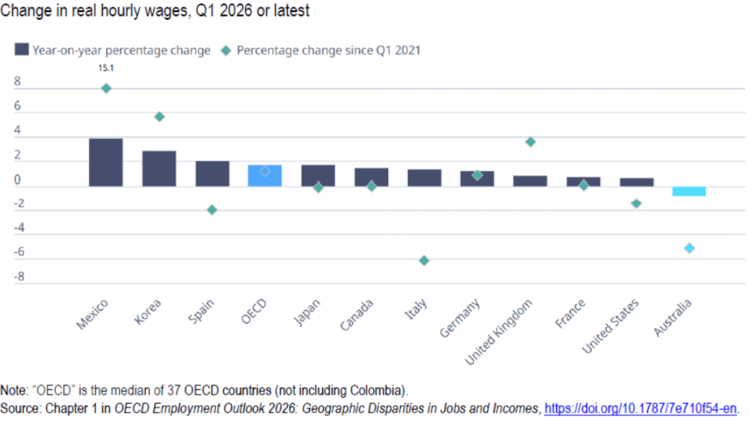
The Organisation for Economic Co-operation and Development (OECD) released its annual Employment Outlook recently, and Australia stands out for an uncomfortable reason. We have one of the strongest jobs markets in the developed world, yet one of the weakest in terms of real wages growth. Real wages being a key indicator of household living standards.
On the surface the numbers are enviable. Unemployment sits at 4.4% against an OECD average of 4.9%, and labour force participation near 81% places Australia among the best performers anywhere. Notably the OECD’s participation rate refers to those aged 15 to 64 years of age, not the broader 15 years or older like the Australian Bureau of Statistics measures (which leads to a lower rate of 67%). However, real hourly wages have fallen by around 5% since early 2021, among the sharpest declines recorded across member countries.
The real minimum wage also went backwards over the year to April, and Australia was one of just eleven member countries where that happened. Persistent inflation is the reason, as the trimmed mean Consumer Price Index, the Reserve Bank's preferred measure of price pressure, rose to 3.6% in May. Deloitte expects wages to grow 3.3% this financial year against inflation of 4%, and the OECD sees a further 1% decline in real wages by September, as higher energy prices flow through.
A job has rarely been easier to find, while a pay rise that beats higher cost of living has rarely been harder to get!
This squeeze, uncomfortable as it is, is how the cycle turns. When pay lags prices, households pull back. Business and consumer sentiment are both in pessimistic territory and spending is slowing. Commonwealth Bank economists argue the economy needs this cooler period for inflation to settle back at target. HSBC makes a similar point about property, noting that a softer housing market typically dampens building activity and the household purchases that follow a new home.
The repair will take time. Deloitte notes Australia has not seen such an extended run of soft growth since the recession of the early 1990s. Meanwhile, years of weak productivity means inflation now flares up at lower rates of growth than it once did.
For investors, this suggests holding realistic expectations about the pace of rate relief and treating consumer facing sectors with some care while household budgets remain under pressure. We are watching spending and housing data closely because they will tell us whether the slowdown is delivering the fall in inflation the Reserve Bank needs or whether one final rate rise is required to finish the job.
The week ahead
Locally, the key focus will be Thursday’s labour force data, which will provide an update on job market conditions after unemployment was 4.4% in May.
Overseas, US earnings season will be in focus, with major technology companies including Alphabet and Tesla reporting, giving investors a clearer read on corporate earnings and AI-related spending.


Wade is the head of the Investment Services division at Cutcher & Neale and has over 15 years of industry experience in accounting and investment advisory roles.
Wade guides his division on the belief that investment portfolios should be built on transparency and flexibility. His expertise focuses on direct portfolio exposure to both Australian and Global Investment markets.

-1.png?width=352&name=Investment%20SnapShot%20Header%20-%20July%202025%20(1)-1.png)