
-1.png)
Weekly recap
What happened in markets
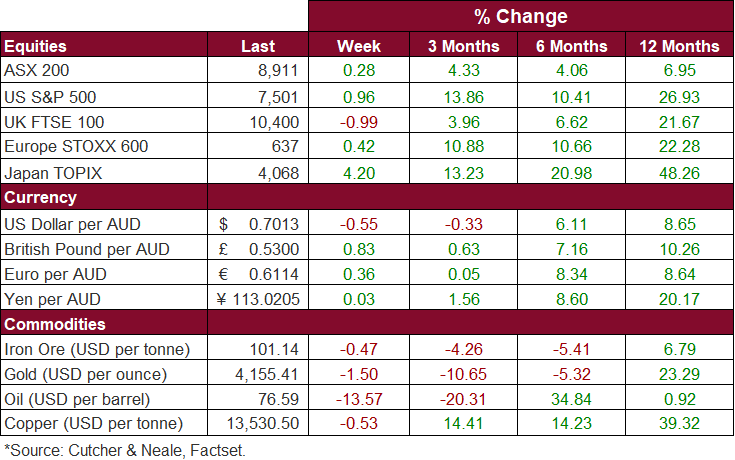
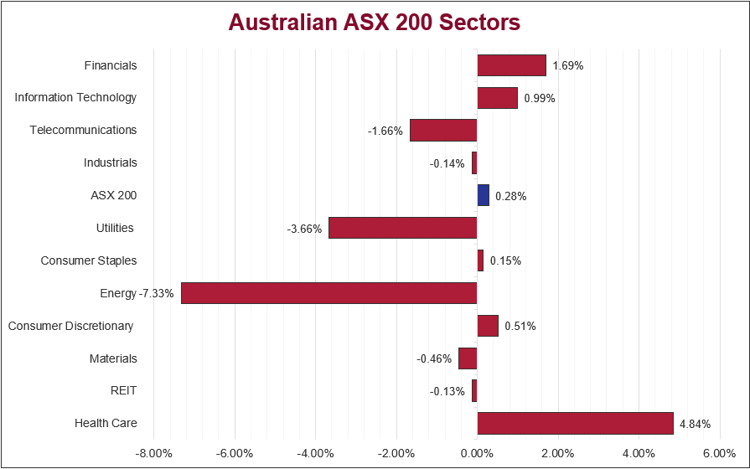
The Australian sharemarket ended the week slightly higher, although performance was very concentrated. Earlier in the week we saw positive performance, thanks to optimism around a US-Iran agreement, followed by the RBA’s hold rate decision. However, later in the week sentiment dropped off following a hawkish tone from the US Federal Reserve, causing materials and commodities to drop, along with a rotation into defensive sectors. Health Care was the best performing sector, doing most of the heavy lifting, advancing 4.8%. Conversely, the Energy sector tumbled 7.3%, driven by a sharp 13.6% decline in oil prices, which saw Rio Tinto drop 3.8%. The stock specific standout of the week was Web Travel, surging 22.9%, after delivering a strong trading update that reinforced confidence in its earnings outlook and ongoing recovery in global travel demand.
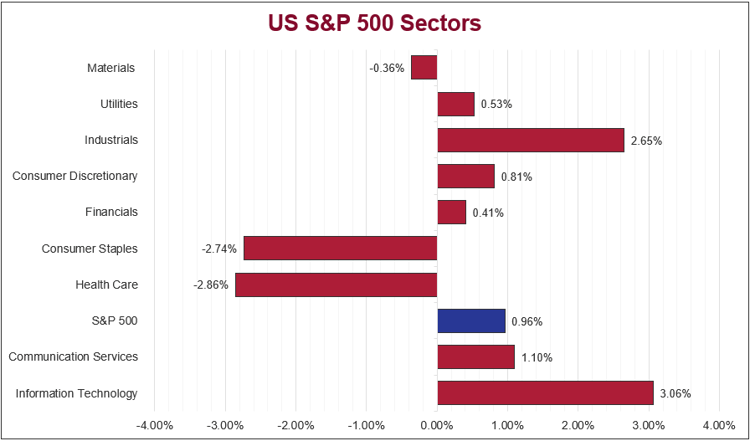
US sharemarkets closed higher last week, supported by improving geopolitical conditions and continued strength in growth sectors. Technology stocks led gains, particularly semiconductor companies, driven by ongoing optimism around artificial intelligence and strong corporate momentum. The US‑Iran agreement improved global energy supply expectations, putting downward pressure on oil prices and easing inflation concerns. However, the Federal Reserve maintained interest rates but adopted a more hawkish stance, removing forward guidance and signalling a higher path for future rates, which pushed short‑term yields higher. The Consumer Staples (-2.7%) and Health Care (-2.9%) were the key detractors, while Industrials (2.7%) and Information Technology (3.1%) drove the market higher. Global manufacturer of heavy equipment, Caterpillar, which services the construction, mining, energy and infrastructure industries, jumped 8.3%, supported by surging demand for its equipment in the data centre builds, which saw its order backlog jump to a record US $63 billion.
European sharemarkets also finished the week slightly higher, supported by easing geopolitical tensions and improving investor sentiment. The US‑Iran framework agreement was the key driver, as lower energy prices helped improve the economic outlook and supported risk appetite. This saw the STOXX Europe 600 reach fresh highs and prompted some analysts to lift their expectations for the region. Banks and industrials led gains, benefitting from a stronger macro backdrop and structural growth themes such as defence and infrastructure spending. However, central bank policy remained in focus, with a broadly hawkish stance despite signs of softer growth. Political uncertainty in the UK also emerged as a potential risk, adding to the cautious outlook.
Stock & sector movements

What caught our eye
When Enthusiasm Outruns the Numbers
SpaceX has just completed the largest sharemarket debut in history, and the response from investors was remarkable. Australians backed the listing more heavily than any float CommSec has handled in its three decades of operating.
We think this is a moment worth pausing on. Not because the company is unimpressive, quite the contrary, but because the price now attached to it has moved well ahead of what seems rational. The most widely used price-to-earnings metric cannot be used, given SpaceX operates at a loss. Instead, its price-to-sales must be used, with that measure being over 100x. That puts it ahead of even the frothiest of US technology stocks.
The float raised about US$75 billion, the largest listing on record and more than two and a half times the size of Saudi Aramco’s offering in 2019. Since listing at US$135, the shares have risen well beyond that, at times trading above US$200 and lifting the company’s value to over US$2.5 trillion. The listing made its largest shareholder, Elon Musk, the world’s first trillionaire on paper. It was also enough to raise its value above Amazon temporarily, making SpaceX one of the most valuable companies in the world.
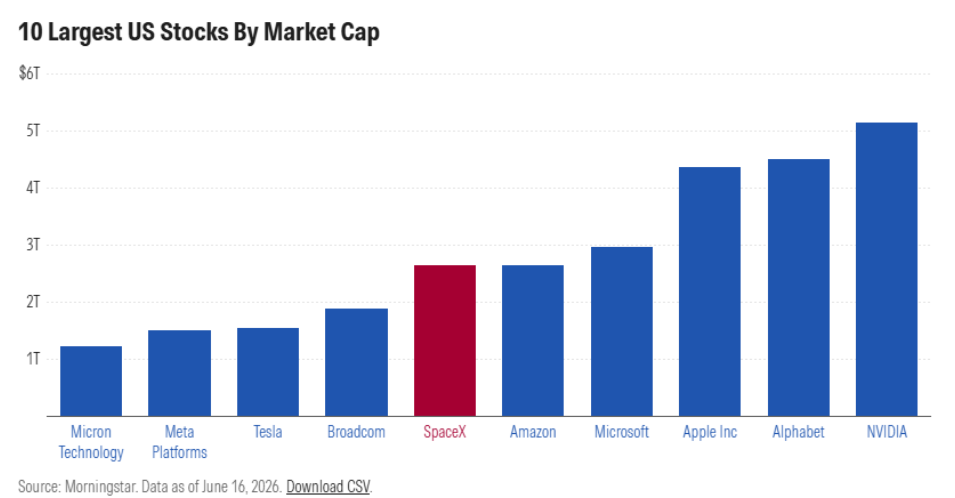
A comparison with Amazon can help ground investors. In a single recent quarter, Amazon earned about US$30 billion in profit. Over the same period, SpaceX lost more than US$4 billion.
This reality didn’t cool the mood however, as buyers were backing a well marketed opportunity and the figure behind it (Elon Musk) rather than the company’s financial record. SpaceX became CommSec’s biggest ever IPO by a factor of four, measured by the number of retail account participants, which totalled over 28,000. It is also worth knowing that only around 4% of SpaceX’s shares trade freely on the open market, and that scarcity helps explain how the price has climbed so fast.
Adding some sense to what is driving the surge arrived within days of listing. On 16 June, SpaceX announced it would buy Cursor, a fast-growing artificial intelligence coding tool, for about US$60 billion in its own stock. That news was what pushed the shares past US$200 and lifted SpaceX above Amazon. The deal also helps explain why investors are paying up. SpaceX is no longer simply a rocket company. It absorbed Elon Musk’s artificial intelligence venture xAI earlier this year, and much of its case to investors now rests on a vast and largely untested artificial intelligence opportunity rather than on what it earns today.
For investors, the useful distinction here is between a remarkable company and a reasonable price. The two are not the same thing, and a story about the future, though compelling, needs to be somewhat grounded in reality. We are not dismissing what SpaceX may one day become. We are noting that buying near the top of a wave of excitement carries a different risk to buying a quality, profitable business, and that smaller shareholders can find themselves diluted later if larger holders eventually sell down.
The sensible response is neither to chase the excitement nor to mock it, but to size any holding responsibly in the context of one’s overall portfolio. We will be watching whether the company can grow into its valuation, which will most likely be measured in months and years rather than days and weeks.
The week ahead
Locally, attention will turn to upcoming economic indicators and continued commentary from the RBA, with markets looking for further clarity around the interest rate outlook and domestic growth conditions.
Overseas, the focus will be on a raft of economic data out of the US including retail sales, housing data and sentiment indicators for signs of consumer resilience. In China, industrial production and retail sales will also be closely monitored for signals on growth momentum.


Wade is the head of the Investment Services division at Cutcher & Neale and has over 15 years of industry experience in accounting and investment advisory roles.
Wade guides his division on the belief that investment portfolios should be built on transparency and flexibility. His expertise focuses on direct portfolio exposure to both Australian and Global Investment markets.
-1.png?width=352&name=Investment%20SnapShot%20Header%20-%20July%202025%20(1)-1.png)