
Weekly recap
What happened in markets
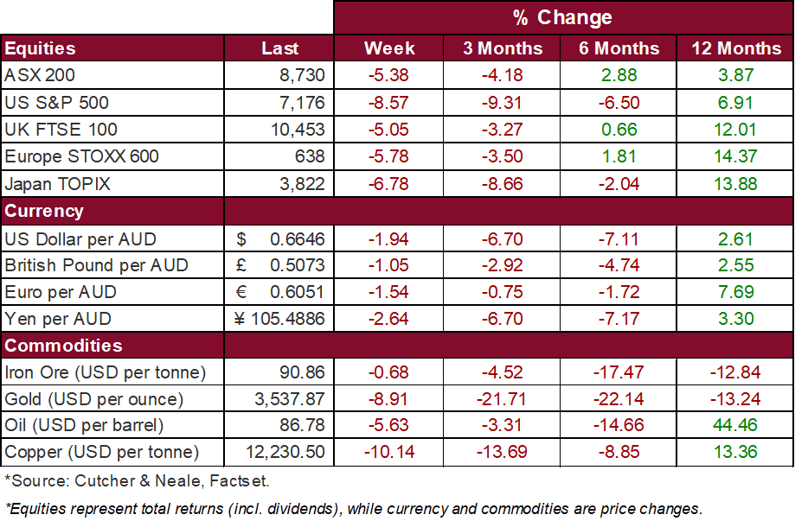
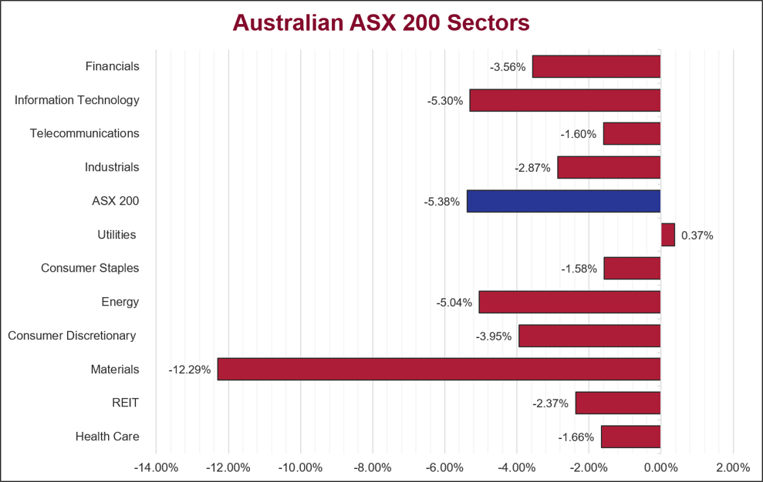
The Australian sharemarket recorded its worst weekly performance since June 2020, with the ASX 200 declining 5.4%, following broad-based selling and weaker global sentiment. The Materials sector (-12.3%) was the largest drag as gold, copper and iron ore prices weakened amid concerns over Chinese demand and AI infrastructure investment. The Information Technology sector (-5.3%) also struggled, with Megaport falling 17.0% as the global technology sell-off spread to Australian technology shares, while the Energy sector (-5.0%) declined alongside softer commodity markets. In contrast, Utilities (+0.4%) was the only sector to finish higher. Overall, surprisingly weak employment data came in at a five-year high of 4.9%, prompting markets to price out further RBA rate hikes.
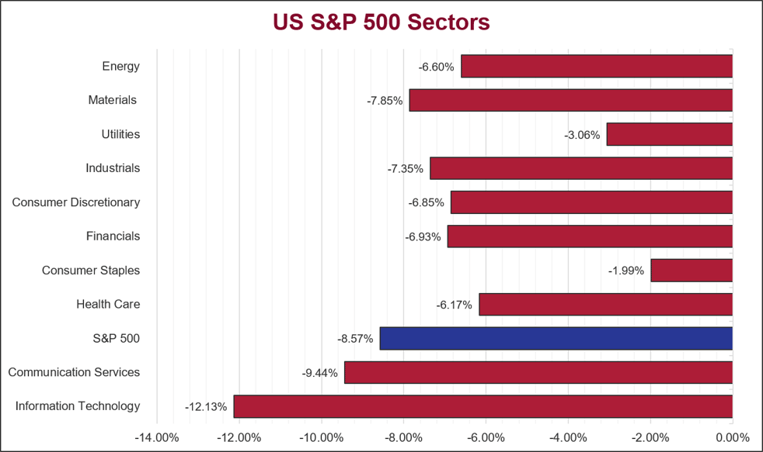
The US sharemarkets fell sharply over the week, with the S&P 500 declining 8.6% and the Nasdaq falling 10.0%, as concerns around AI investment, regulation and tighter financial conditions weighed on sentiment. The Information Technology sector (-12.2%) led losses, despite NVIDIA (-22.9%) reporting stronger-than-expected earnings and guidance, as broader concerns around the AI investment cycle persisted. The Communication Services sector (-9.4%) also significantly underperformed, while the Consumer Staples sector (-2.0%) proved relatively defensive. Selling was widespread, with the S&P 500 recording its worst week since the Liberation Day tariff-driven sell-off in April 2025, while hawkish Federal Reserve commentary and expectations for further rate hikes added to market pressure.
The European sharemarket endured a similar broad sell-off over the week, with the STOXX Europe 600 falling 5.8% amid renewed concerns around AI spending and tighter financial conditions. The Basic Resources sector (-11.8%) suffered the steepest losses amid weaker metals prices. The Technology sector (-10.6%) tracked the global market as investors reassessed AI valuations and investment returns. The Banks sector (-7.3%) came under pressure amid broader risk aversion, while the Energy sector (-6.8%) declined alongside softer crude prices. The Retail sector (-2.4%) proved comparatively resilient as investors rotated toward more defensive, consumer-facing companies.
Stock & sector movements

What caught our eye
A Record El Niño
The El Niño now sitting over the Pacific has reached record strength. Sea surface temperatures were running 3.1 degrees above normal in the middle of November, well past the 2.0 degree mark that defines a super event.
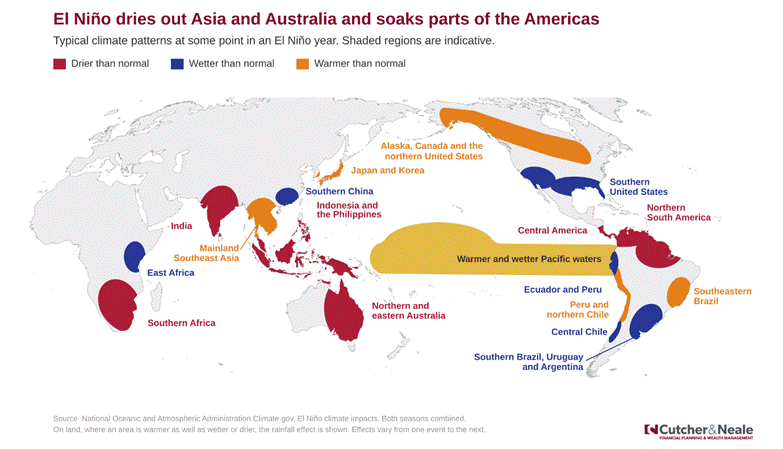
El Niño is a natural warming of the tropical Pacific that arrives every few years and usually lasts about a year. The extra heat passes into the atmosphere and shifts where rain falls. Southeast Asia, India and Australia tend to turn hot and dry, while parts of the Americas turn wetter. Harvests, hydro power and shipping feel it first, which is how warm water ends up in food prices.
Our view is that it will matter a great deal in some places and for some foods, and far less in others. For inflation across developed economies, its impact is probably less than feared at face value.
The food data shows the split clearly. The United Nations food price index was 5.9% higher in October than a year earlier. Cereal prices fell 4.5% in the month as wheat eased, while sugar rose 6.6% on weather trouble in Brazil, India and Thailand. Rice, Asia’s main staple, has kept climbing.
El Niño is also not bad for every crop. Analysts estimate it hurts yields across up to a quarter of the world’s farmland and improves them across about a third, with soybeans often benefitting. Notably, stock levels, more than the weather, have decided how far prices moved in past episodes. Sugar and robusta coffee have thin buffers this time, while cocoa is better stocked than during the previous El Niño.
For inflation, what matters is how much of the household budget goes on food. Food is about 17% of the consumer price basket in Australia, 15% in the US and 18% in the Eurozone. In the Philippines, rice alone is close to 9%. That is why the pressure is showing first in emerging markets. Indian food inflation, excluding vegetables, has doubled since April to 8%.
The economic cost is concentrated in the same way. Citigroup puts the possible loss from a super El Niño at US$5 trillion to US$7 trillion of world output over five years. It calls these rough estimates and says the damage falls mainly on tropical farming economies.
Energy is where the weather meets this year’s other shock. The Middle East conflict has left oil more than 40% dearer than a year ago, and Europe began winter with gas storage at its lowest in more than a decade. Some meteorologists believe El Niño could lead to a milder than normal winter across Europe and the northern US, which would ease heating demand. That matters when gas reserves are so low and prices so high.
Closer to home, Australia is one of the countries El Niño tends to dry out and commodity analysts list our wheat among the most exposed crops. So far the damage has been limited. The government forecaster ABARES expected a smaller wheat harvest this year, but one still above the long run average after a wet winter in the south. The risk sits in the months ahead, and it arrives while inflation is already above the Reserve Bank’s target.
The week ahead
Locally, we are focused on Wednesday’s Consumer Price Index (CPI) data. Following this week’s surprisingly high unemployment figures, the CPI result will provide further insight into the impact of the RBA’s recent interest rate hikes and whether this is already being reflected in inflation data.
Overseas, ahead of the Thanksgiving weekend, US markets are closed on Thursday. US economic releases include the October Personal Consumption Expenditures (PCE) inflation and the second estimate for Q3 GDP growth. Together, these reports will help shape market expectations for future interest rate movements by indicating whether inflation remains persistent while economic growth remains resilient.


Wade is the head of the Investment Services division at Cutcher & Neale and has over 15 years of industry experience in accounting and investment advisory roles.
Wade guides his division on the belief that investment portfolios should be built on transparency and flexibility. His expertise focuses on direct portfolio exposure to both Australian and Global Investment markets.