

Weekly recap
What happened in markets
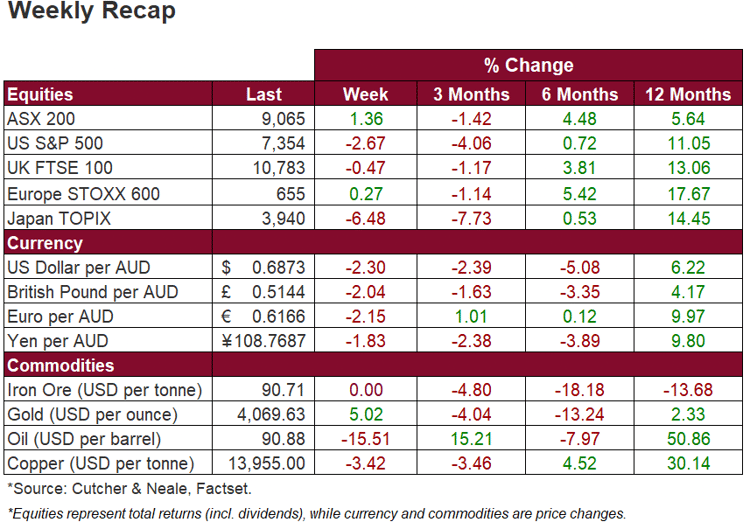
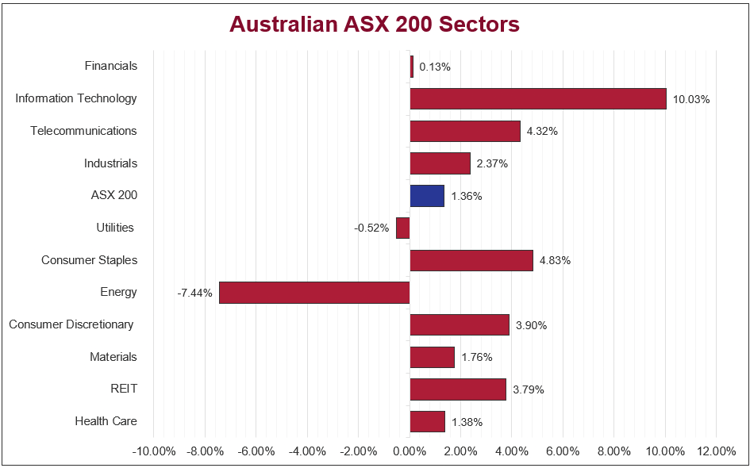
The Australian sharemarket finished the week higher, with the ASX 200 gaining 1.4%, despite elevated volatility across global equity markets. The strongest gains came from the Information Technology (+10.0%), Consumer Staples (+4.8%), Telecommunications (+4.3%), Consumer Discretionary (+3.9%) and REITs (+3.8%) sectors, while Industrials (+2.4%), Materials (+1.8%) and Health Care (+1.4%) sectors also advanced. Technology was the standout, supported by a 77.2% surge in NEXTDC shares following significant buying interest from Goodman Group and Digital Realty. In contrast, the Energy (-7.4%) sector was the clear laggard, as oil prices fell sharply over the week, while the Utilities (-0.5%) sector also declined. Financials were broadly flat (+0.1%). Overall, the Australian market proved relatively resilient despite weakness across global equities, with strong gains across technology, consumer and property-related sectors helping the ASX 200 finish the week firmly higher.
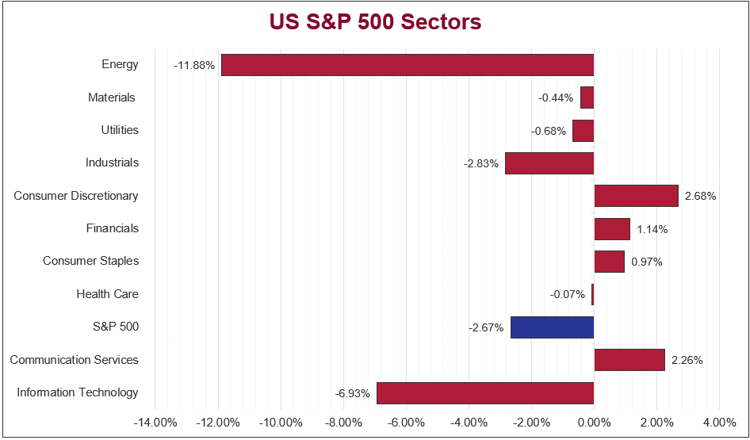
The US sharemarkets pulled back over the week, with the S&P 500 declining 2.7%, as sharp weakness in technology and energy outweighed gains elsewhere. The Information Technology (-6.9%) sector was a major detractor, with semiconductor and AI-related shares under pressure as investors reassessed elevated valuations and concerns around the outlook for data-centre investment, despite a partial rebound on Friday. The Energy (-11.9%) sector was the weakest sector of the week, as oil prices fell sharply amid renewed hopes for a diplomatic resolution to the US-Iran conflict. The Industrials (-2.8%) sector also declined, while Health Care (-0.1%) sector was broadly flat. In contrast, the Consumer Discretionary (+2.7%), Communication Services (+2.3%), Financials (+1.1%) and Consumer Staples (+1.00%) sectors all recorded gains. Overall, the week’s decline was concentrated in technology and energy, with strength across several other sectors highlighting a continued rotation away from parts of the growth market.
The European sharemarket edged higher over the week, with the STOXX Europe 600 gaining 0.3%, outperforming the weaker US market amid significant sector dispersion. The Travel & Leisure (+7.0%) sector led the advance, while Health Care (+4.6%), Banks (+3.7%), Construction & Materials (+3.4%), Automobile & Parts (+3.1%) and Retail (+3.1%) sectors also recorded strong gains. Health Care was particularly resilient during the broader global equity sell-off. In contrast, the Energy (-5.7%) sector weakened as oil prices fell sharply, while the Technology (-4.1%) sector was pressured by the global sell-off in technology and AI-related shares. The Telecommunications (-1.6%) sector also declined.
Stock & sector movements

What caught our eye
The Slowdown That Won't Bring Rates Down
The Reserve Bank lifted the cash rate by 0.25% last week, its fifth increase this year, taking the rate to 4.85%. In the same week, one of the major bank economics teams released a revised set of forecasts showing the Australian economy slowing more sharply and for longer than previously thought. Interest rates rising while growth forecasts fall is an unusual combination worth understanding.
The updated forecast from the major bank paints a soft picture.
-
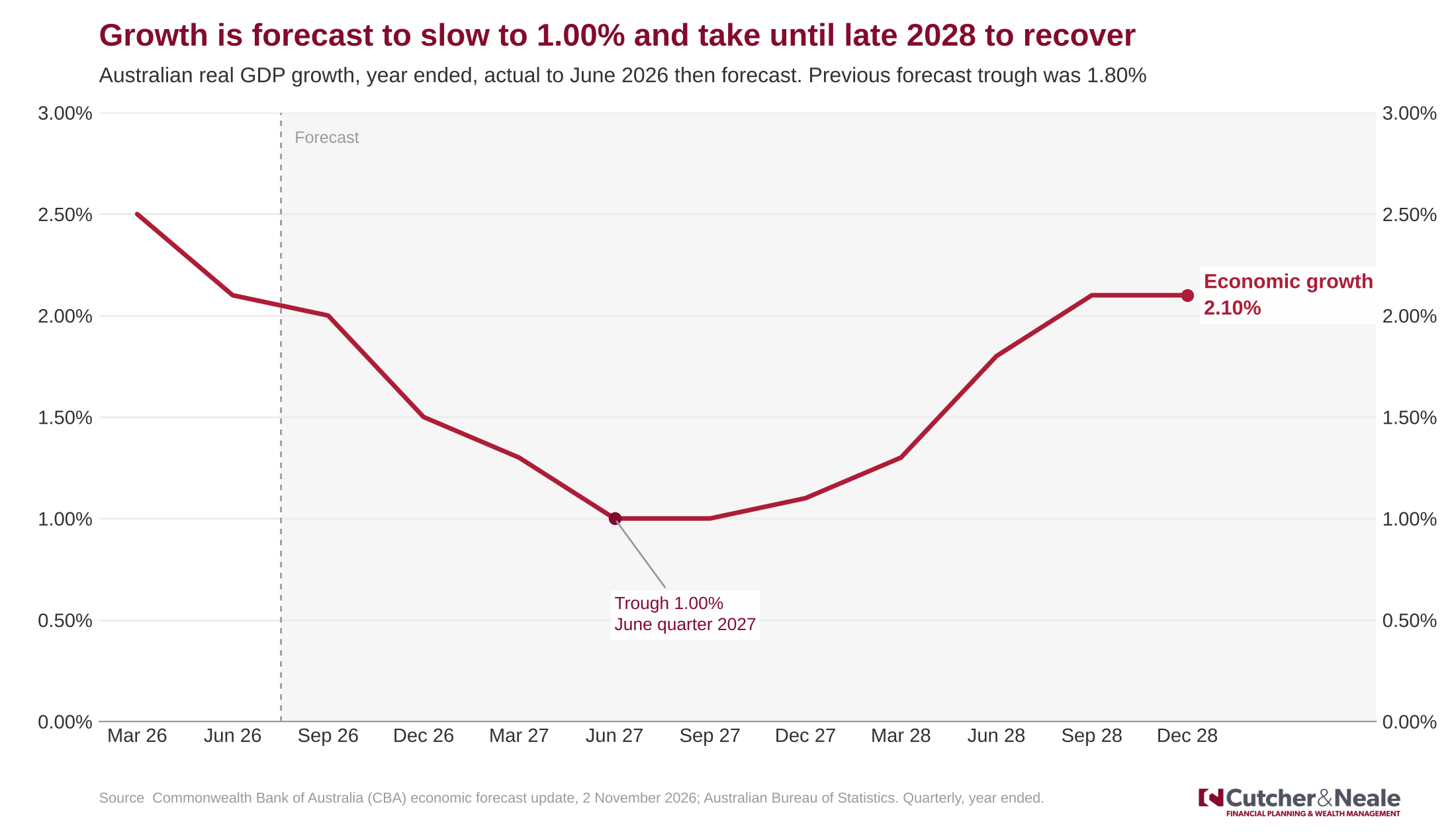
Growth is expected to bottom at just 1.0% in mid-2027, down from an earlier estimate of 1.8%, and not return to its trend pace of 2.0% until late 2028.
-
Unemployment is forecast to climb to 5.1% by the end of next year.
-
Only 0.5% of easing is pencilled in for the second half of 2027, though is uncertain.
In most past cycles those numbers would have had markets pricing a run of rate cuts. Instead, the cash rate has just moved higher.
The reason is that inflation is being driven by forces a cooler domestic economy cannot easily fix. Trimmed mean inflation sat at 3.7% in the September quarter, its fifth straight reading above 3.0%, and it is not expected to fall below 3.0% until early 2028. Three structural pressures stand out.
-
Oil has climbed above US$100 a barrel on the back of the conflict in the Middle East and the flow through refined fuels has been larger again.
-
The global build of AI data centres is lifting the cost of chips and electronics and pushing up central bank neutral interest rates.
-
Australian productivity growth remains close to zero, which has prompted forecasters to raise their estimate of the neutral unemployment rate to 4.8%.
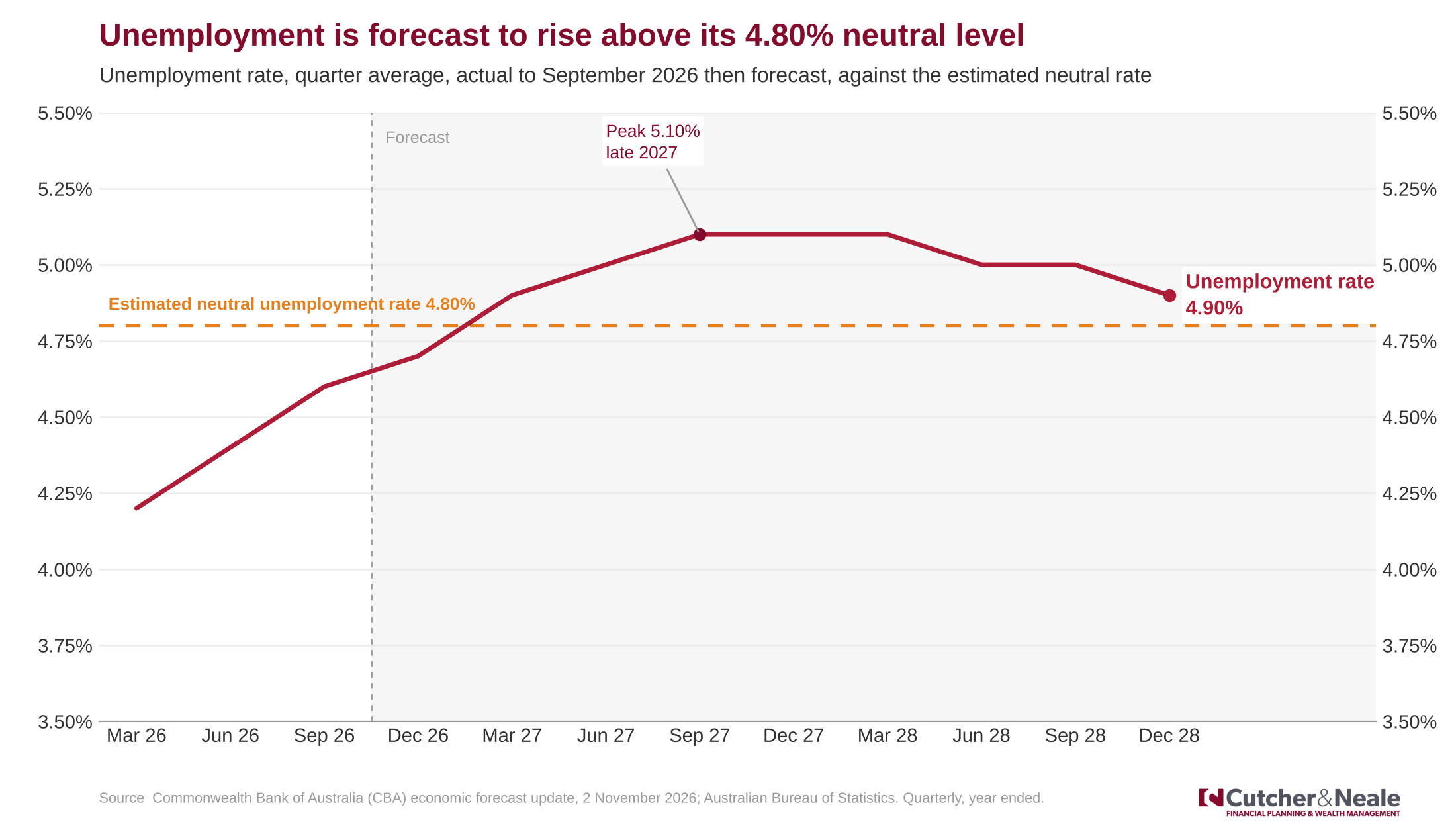
Put those together and you have an economy whose capacity to grow without generating inflation has shrunk. That is why last week's increase leaves monetary policy at its tightest setting in more than 25 years, yet the main risk is still described as potential further tightening rather than relief.
The lever the Reserve Bank controls works on demand. The problems sit largely on the supply side. Slower spending will help at the margin, but we agree with the view that each percentage point of growth given up is likely to buy less disinflation than it did previously.
This points to an environment where higher for longer is the base case rather than a passing phase. A few things matter for portfolios from here.
-
Quality comes first. Businesses with genuine pricing power, sound balance sheets and limited exposure to discretionary household spending are better placed to protect margins while costs stay elevated.
-
Real assets and infrastructure with inflation linked revenues earn their place.
-
We are watching the December quarter inflation data and the Mid-Year Economic and Fiscal Outlook closely, because fiscal policy will matter if the RBA cannot carry the load alone.
-
Household savings remain resilient, so this is a grind rather than a crisis.
The economy is slowing, but until productivity improves or energy prices normalise, we expect interest rates to stay higher than the growth numbers alone would suggest.
The week ahead
Locally: This week in Australia, focus is consumer and business confidence.
Overseas: In the US, CPI and inflation data will take precedent Wednesday and Thursday when a large array of data gets released including PPI and retail sales. In the Eurozone, GDP growth is the primary datapoint of the week.


Wade is the head of the Investment Services division at Cutcher & Neale and has over 15 years of industry experience in accounting and investment advisory roles.
Wade guides his division on the belief that investment portfolios should be built on transparency and flexibility. His expertise focuses on direct portfolio exposure to both Australian and Global Investment markets.