.png)
|
|
Quick TakeMarkets moved in different directions in July: European and Australian equities advanced while US markets slipped, with the S&P 500 easing 0.06%, the Nasdaq falling 3.19% and the Russell 2000 declining 3.03%. The STOXX Europe 600 rose 1.27% and the ASX 200 gained 2.26%. Renewed conflict involving Iran drove oil prices 18.42% higher, while investors began questioning the returns on artificial intelligence spending. The United States gave back ground: A shift in focus from artificial intelligence demand to the returns on the capital being invested prompted a sharp unwinding of crowded positions, overshadowing a strong earnings season in which 86% of reporting companies had beaten expectations so far. Jobless claims fell to their lowest since 1969 and inflation was cooler than expected, but the Federal Reserve held rates at 3.50% to 3.75% and markets moved to price an increase in September. Europe and Australia advanced: European equities recorded a fourth consecutive monthly gain despite higher energy costs and German bond yields at a 15-year high, while Australia’s market also rose for a fourth month as the Reserve Bank stayed on hold. Investors now face the question of whether artificial intelligence spending will earn its keep, and whether rising energy costs force central banks to tighten policy further. |
|
Snapshot
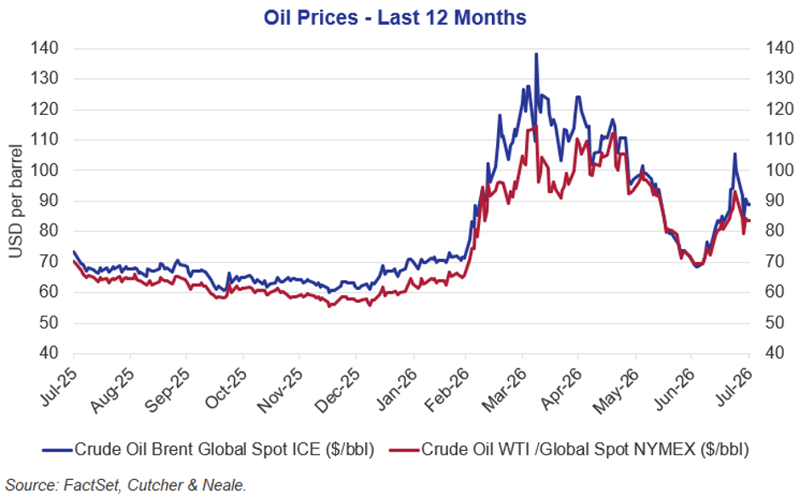
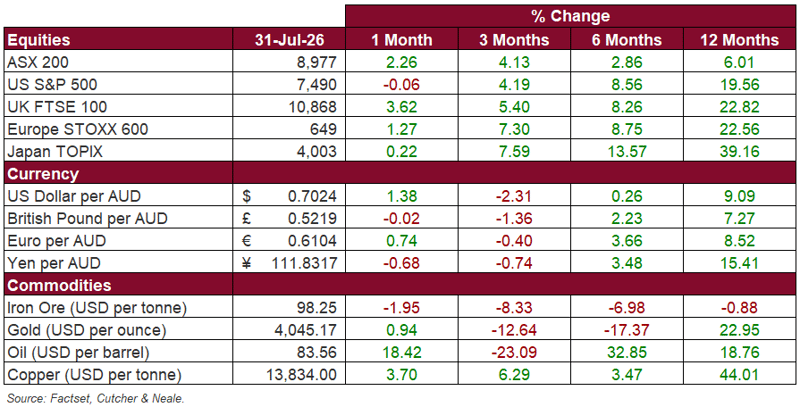 Global equity markets were mixed in July, with solid gains in Europe and Australia offset by losses in the United States. In the United States, the S&P 500 eased 0.06%, the Nasdaq fell 3.19% and the Russell 2000 declined 3.03%. European markets moved higher, with the STOXX Europe 600 up 1.27%, the FTSE 100 rising 3.62%, the DAX gaining 2.53% and the CAC increasing 1.33%. In Australia, the ASX 200 rose 2.26%. Two themes dominated the month. Renewed hostilities involving Iran drove oil prices 18.42% higher and lifted bond yields around the world, while investors began to question the returns on the enormous sums being committed to artificial intelligence.
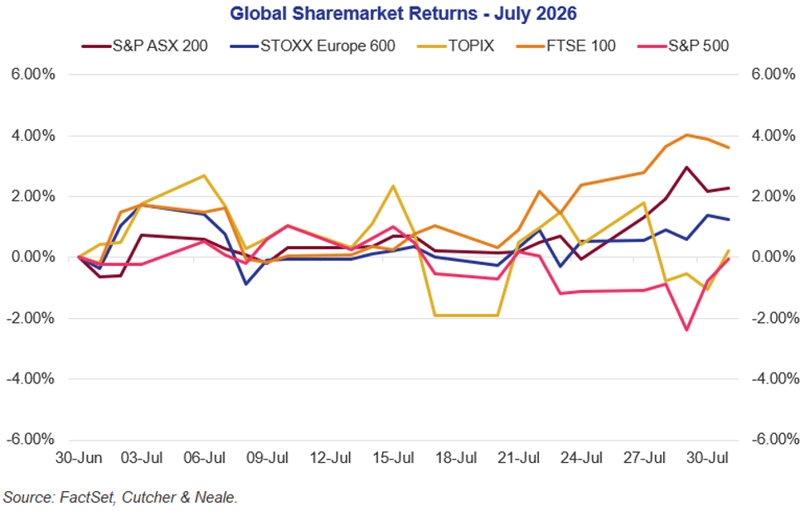
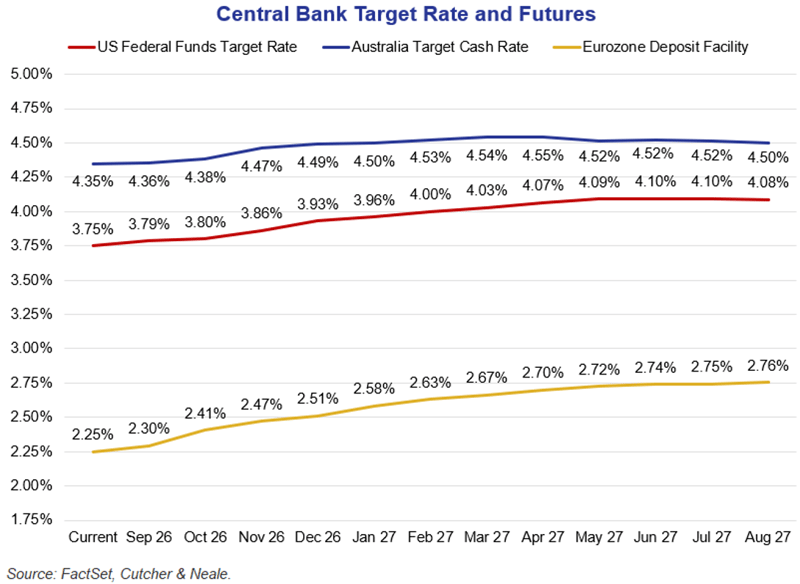
In the United States, the debate around artificial intelligence shifted from whether demand would hold up to whether the capital being spent will earn an adequate return. That change in emphasis triggered a sharp unwinding of crowded positions, which weighed on the major indices even as company results were strong. With just over 60% of the S&P 500 having reported, 86% of companies had exceeded earnings expectations. Economic data was also encouraging, with initial jobless claims falling to their lowest level since 1969 and inflation readings coming in cooler than expected. The Federal Reserve left rates unchanged at 3.50% to 3.75%, although three officials preferred a 0.25% increase, and markets moved to price a rise in September. Bond yields rose across the curve, with the 30-year yield reaching its highest level since 2007, and new tariffs of between 10% and 12.5% were announced on around 60 economies.
European markets extended their run, with the STOXX Europe 600 recording a fourth consecutive monthly gain and reaching a fresh record high, although the month was far from smooth. Renewed conflict in the Middle East and disruption around the Strait of Hormuz pushed Brent crude towards US$100 a barrel and drove European gas prices sharply higher, taking German 10-year bond yields to a 15-year high. Even so, activity proved more resilient than feared, with business surveys improving and Eurozone growth returning in the second quarter, while inflation remained relatively contained at 2.9%. The European Central Bank left policy unchanged, with President Lagarde pointing to September and two further months of data, and the Bank of England also held, in a 6 to 3 vote. In the United Kingdom, the appointment of a new prime minister and chancellor renewed questions about fiscal credibility and pushed longer-dated gilt yields higher.
 In Australia, the ASX 200 rose 2.26%, a fourth straight monthly gain that left the index within touching distance of its record high, with volumes thinning as investors waited for the August reporting season. The Reserve Bank did not meet in July, but Governor Bullock said further easing in demand growth is likely to be required and that the board is prepared to raise the cash rate again if needed, with inflation the overriding concern. The data pulled in both directions. Employment surged in June, the largest monthly increase since April 2025, while trimmed mean inflation for the June quarter came in below both consensus and the Bank’s own forecasts. Markets responded by pricing out an August increase, with the probability of a rise by year end falling to around 50% from about 90%. The Australian dollar rose 1.38% to US$0.7024 and the 10-year government bond yield increased to 4.93%.
Overall, July was a month in which markets kept moving forward while quietly changing leadership, with strength outside the United States offsetting the unwinding of the most crowded positions. Earnings and economic data remain supportive, but energy costs are rising and central banks are once again talking about tightening rather than easing. The key question from here is whether the returns on artificial intelligence investment justify the spending, and whether higher oil prices force policymakers to act.

Key Stocks



Ryan joined Cutcher & Neale as a Portfolio Manager in January 2023, bringing nearly 20 years of financial markets experience to the firm. Specialising in fundamental equity analysis and multi-asset strategies, Ryan holds the Chartered Financial Analyst (CFA) designation. He is responsible for the risk and return outcomes of the firm’s Managed Discretionary Account (MDA) portfolios on the Mason Stevens platform.
.png?width=352&name=Investment%20SnapShot%20Header%20-%202026%20(3).png)