
.png)
|
|
Quick TakeGlobal markets were mixed in June: The S&P 500 fell 0.95% and the Nasdaq declined 2.75%, while the Russell 2000 rose 3.74% as gains broadened. Europe's STOXX Europe 600 gained 2.67% to a fresh record and Australia's ASX 200 rose 0.67%. A US-Iran ceasefire reopened the Strait of Hormuz and sent oil prices sharply lower, though a rotation within the artificial intelligence trade and a more hawkish central bank tone tempered sentiment. |
|
Snapshot
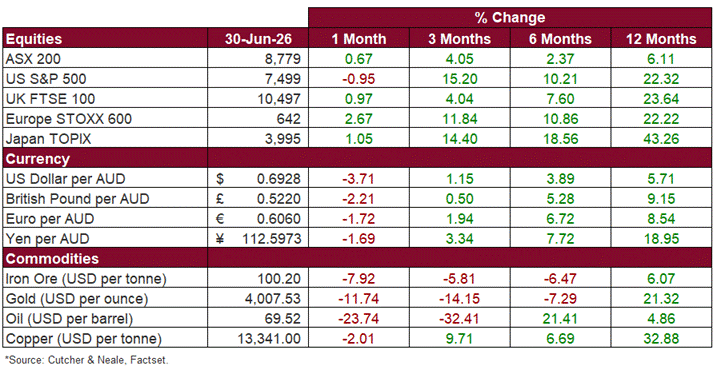 Global equity markets were mixed in June, with several indices touching fresh record highs early in the month before giving back ground. In the United States, the S&P 500 fell 0.95% and the Nasdaq declined 2.75%, while the smaller-company Russell 2000 rose 3.74% as gains broadened. European markets were mostly higher, with the STOXX Europe 600 up 2.67%, the FTSE 100 rising 0.97%, the CAC gaining 2.99%, and the DAX slipping 0.43%. In Australia, the ASX 200 rose 0.67%. The month was shaped by a US-Iran ceasefire, which reopened the Strait of Hormuz and sent oil prices sharply lower, a substantial rotation within the artificial intelligence trade, and a more hawkish tone from several central banks.
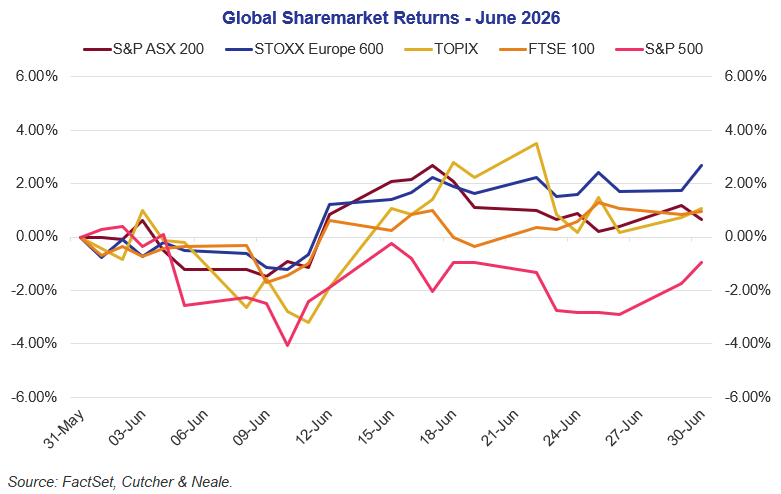
In the United States, the major indices were mixed. The most significant development was a ceasefire with Iran, which reopened the Strait of Hormuz and began a 60-day window for further talks. Oil prices fell sharply as shipping flows recovered, ending the month near pre-war levels, although tensions flared again late in June. Beneath the surface, a substantial rotation ran through the artificial intelligence trade, with many of the largest companies shedding more than US $2 trillion in their worst month in over a year. New share offerings added to equity supply, and confidence in the AI theme was tested by questions over returns on heavy investment. The Federal Reserve, under its new Chair Kevin Warsh, struck a hawkish tone, removing forward guidance and prompting markets to price interest rate rises rather than cuts. Economic data stayed resilient.
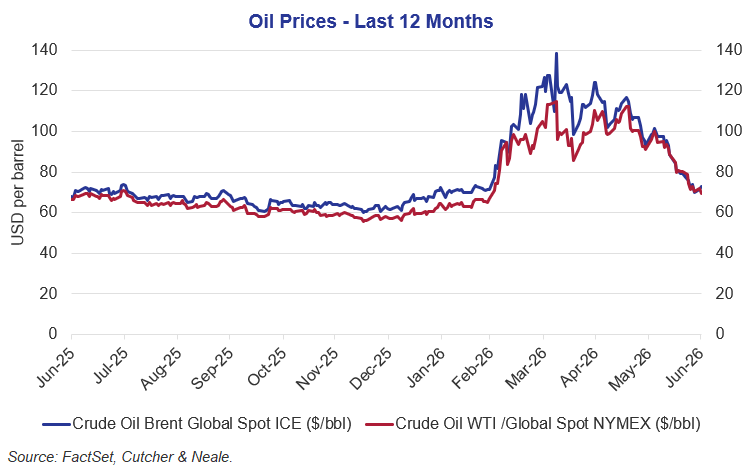 European markets were mostly higher, with the STOXX Europe 600 (up 2.67%) reaching a new record high late in the month. The same easing in Middle East tensions pulled oil down from above US $100 a barrel to multi-month lows. As energy costs fell, bond yields moved lower and expectations for further tightening softened. The European Central Bank delivered a widely anticipated rate rise, though markets increasingly saw it as the likely high point of the cycle, while a Bank of England rise was almost entirely priced out. Broader data pointed to a slowing but stabilising economy, and sentiment towards European equities turned more constructive. The German market lagged on continued manufacturing weakness, while the UK was weighed down by political uncertainty after Prime Minister Keir Starmer resigned following a by-election defeat.
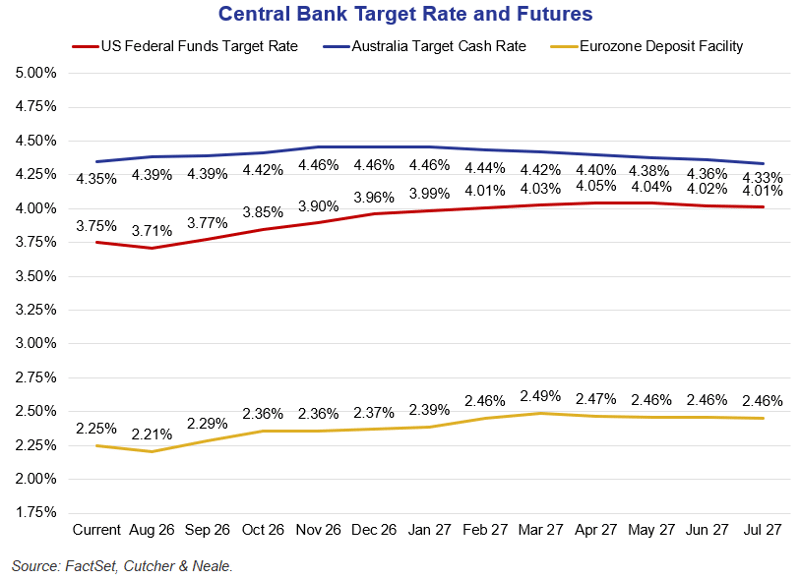
In Australia, the ASX 200 rose 0.67% to 8,779, a third consecutive monthly gain that left it 4.59% below its February record high. Early weakness reversed mid-month as the US-Iran agreement eased tensions and lifted risk sentiment. The Reserve Bank of Australia left the cash rate unchanged at 4.35% in a unanimous decision, following three consecutive rises, noting financial conditions had tightened and the economy was slowing as expected. The tone was marginally more dovish, though the Board maintained that inflation remains too high. Headline inflation eased to 4.0% over the year to May on lower fuel prices, although trimmed mean inflation rose to 3.6%, firmer than expected. Employment rebounded and the unemployment rate eased to 4.4%. With markets increasingly of the view that the RBA's tightening cycle may be complete, and the Fed turning more hawkish, the Australian dollar fell 3.71% to US $0.6928, its weakest month since December 2024.
Overall, June was a more mixed month after a strong run, with easing geopolitical tensions and lower oil prices offset by a wobble in the artificial intelligence trade and a firmer tone from central banks. Gains showed signs of broadening beyond the largest companies, supported by resilient economic data. The key question now will be whether that broadening can be sustained, or whether doubts about AI returns and higher-for-longer interest rates begin to weigh more heavily from here.

Key Stocks



Ryan joined Cutcher & Neale as a Portfolio Manager in January 2023, bringing nearly 20 years of financial markets experience to the firm. Specialising in fundamental equity analysis and multi-asset strategies, Ryan holds the Chartered Financial Analyst (CFA) designation. He is responsible for the risk and return outcomes of the firm’s Managed Discretionary Account (MDA) portfolios on the Mason Stevens platform.
.png?width=352&name=Investment%20SnapShot%20Header%20-%202026%20(3).png)