

|
|
Quick TakeMarkets edged higher in August: US equities led again, with the S&P 500 rising 2.72%, the Nasdaq gaining 3.99% and the Russell 2000 advancing 0.98%. In Europe, the STOXX Europe 600 rose 0.51%, while Australia’s ASX 200 gained 1.54%. Solid company earnings supported markets, offset by a sharp rise in long-term bond yields and growing expectations of further rate rises. The United States recovered after two weaker months: Artificial intelligence remained the dominant theme, with a succession of selloffs and rebounds. Markets continued to expect a Federal Reserve rate rise in September, a view reinforced by hawkish commentary at the Jackson Hole symposium. Economic data was mixed, with inflation in line with expectations but employment, retail sales and consumer sentiment all softer. Europe and Australia also advanced: European markets were uneven, as some of the strongest earnings growth in years offset multi-year highs in government bond yields and budget uncertainty. In Australia, the Reserve Bank held the cash rate at 4.35% while retaining a tightening bias, and company earnings replaced geopolitics as the main driver. The key question from here is whether earnings strength can keep outweighing higher borrowing costs and the prospect of further rate rises. |
|
Snapshot
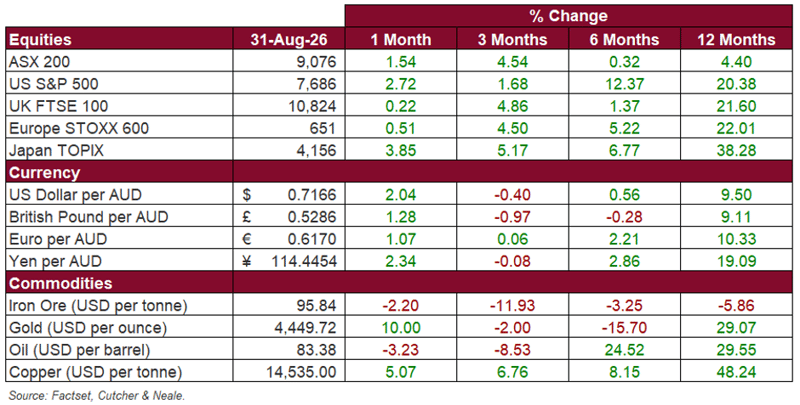
Global equity markets were mostly higher in August, though gains were uneven across regions. In the United States, the S&P 500 rose 2.72%, the Nasdaq gained 3.99% and the Russell 2000 advanced 0.98%. In Europe, the STOXX Europe 600 rose 0.51% and the FTSE 100 gained 0.22%, while the DAX increased 2.45% and the CAC fell 2.06%. In Australia, the ASX 200 rose 1.54%. Every region was shaped by continued debate over the pace and funding of artificial intelligence investment, a sharp rise in long-term government bond yields as investors focused on government borrowing, and growing acceptance that central banks are now more likely to raise interest rates than cut them.
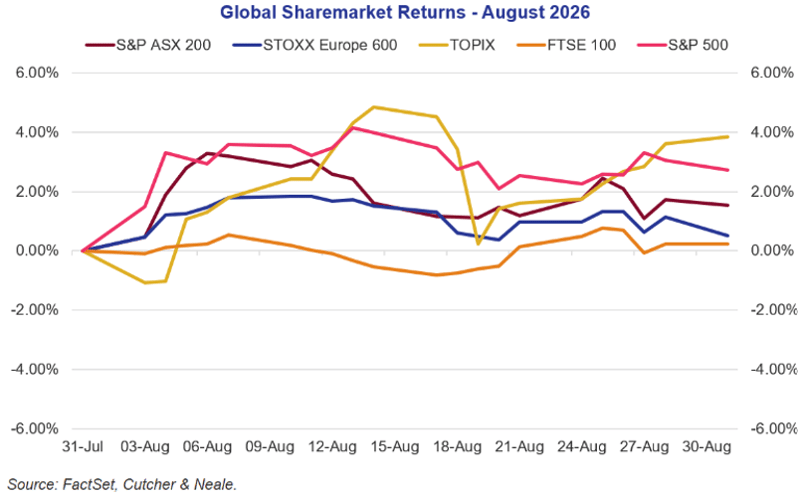
In the United States, share markets recovered after two months of declines. Artificial intelligence remained the dominant influence, with a succession of selloffs and rebounds as optimism about rapid growth in computing demand collided with questions about how that spending is being funded. Markets continued to expect an interest rate rise in September, a view reinforced by hawkish comments from Federal Reserve Chair Warsh at the Jackson Hole symposium, who described recent inflation figures as concerning. Economic data was mixed, with inflation in line with expectations but employment falling for the first time since February and retail sales unexpectedly declining. Long-term bond yields touched their highest levels since the global financial crisis before easing after the US Treasury announced an expanded bond buyback program. The conflict with Iran was quiet for much of the month before escalating late.
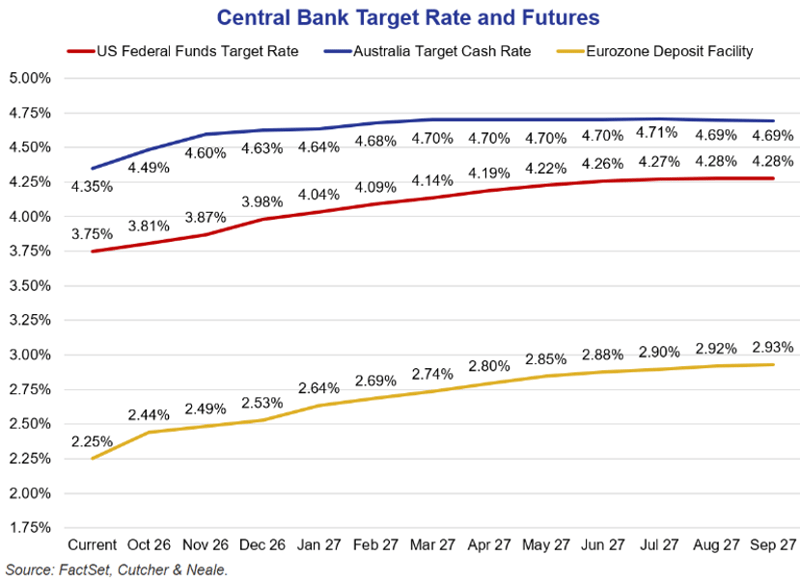
European markets were more mixed. The STOXX Europe 600 rose 0.51%, a fifth consecutive monthly gain, and set a new record early in August, although performance varied widely across the region. The main headwind came from bond markets, where a sharp rise in yields took several benchmarks to multi-year highs. Germany sold 30-year debt at its highest yield since 2011 and UK 10-year yields reached levels last seen in 2007, reflecting investor sensitivity to heavier government borrowing, limited fiscal room in the UK and political uncertainty in France. Offsetting this, corporate earnings were among the strongest in years and economic data surprised on the upside, with Eurozone growth confirmed at 0.4% for the June quarter. Inflation edged higher, with UK inflation accelerating to 2.9% over the year, and the European Central Bank signalled a rate rise in September.
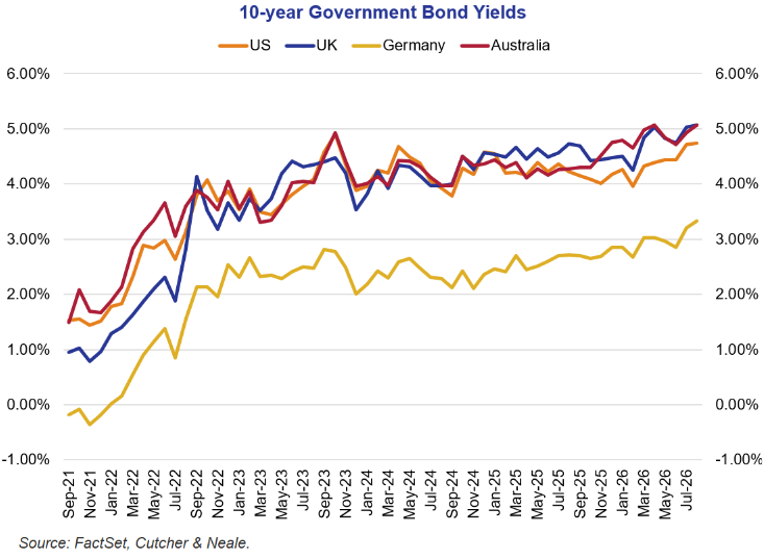
In Australia, the ASX 200 rose 1.54%, a fifth consecutive monthly gain, reaching a record high early in August before easing into month end, with company earnings replacing geopolitics as the main driver. The Reserve Bank held the cash rate at 4.35% in a unanimous decision, retaining a tightening bias should inflation risks materialise, and now expects underlying inflation to return to the upper end of its 2-3% target range by mid-2027. Minutes later revealed the Board had debated a 0.25% increase. Headline inflation eased to 3.5% over the year to July from 3.8%, although this was higher than expected, while trimmed mean inflation held at 3.6%. The labour market softened, with employment falling and unemployment rising to 4.5%, and market pricing for a rate rise increased to 78% from 67%. The Australian dollar rose 2.04% to US$0.7166 and the 10-year government bond yield increased to 5.16%.
Overall, August delivered modest gains for most markets, although conditions remain challenging. For Australian investors, the 2.04% rise in the currency offset most of those gains on unhedged overseas holdings. Rising bond yields, renewed geopolitical tension and central banks leaning towards tighter policy sit alongside a corporate earnings picture that continues to hold up well. The key question from here is whether that earnings strength can keep outweighing the pressure from higher borrowing costs and the prospect of further rate rises.

Key Stocks



Ryan joined Cutcher & Neale as a Portfolio Manager in January 2023, bringing nearly 20 years of financial markets experience to the firm. Specialising in fundamental equity analysis and multi-asset strategies, Ryan holds the Chartered Financial Analyst (CFA) designation. He is responsible for the risk and return outcomes of the firm’s Managed Discretionary Account (MDA) portfolios on the Mason Stevens platform.
.png?width=352&name=Investment%20SnapShot%20Header%20-%202026%20(3).png)