-1.png)
Weekly recap
What happened in markets
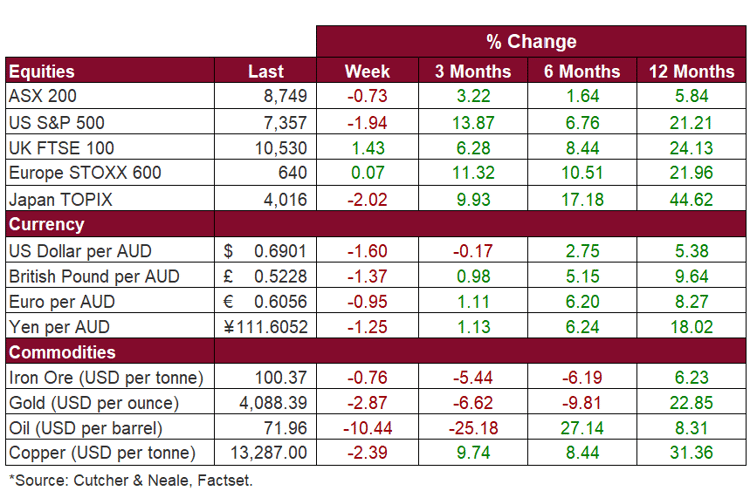
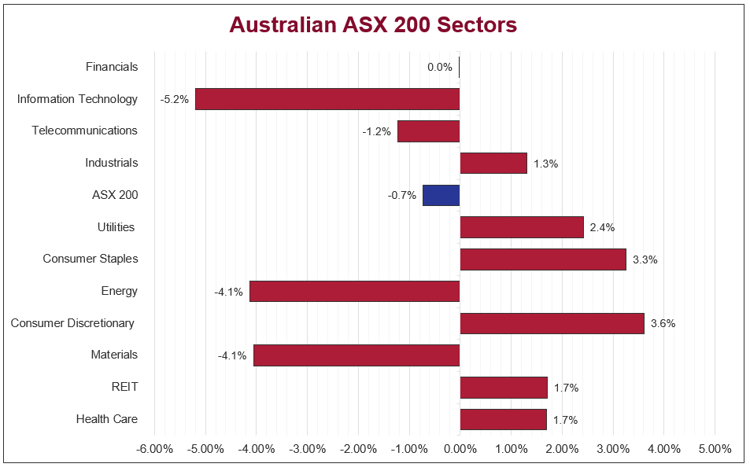
The Australian sharemarket finished the week lower, with the ASX 200 down -0.7% following a volatile and headline-driven period, with developments around US‑Iran negotiations and mixed domestic data influencing sentiment. Early weakness persisted amid softer commodity prices and pressure on growth sectors, while a brief mid-week rebound failed to offset broader declines. Defensive rotation was evident, with the Consumer Discretionary sector (3.6%) and the Consumer Staples sector (3.3%) outperforming. In contrast, the Information Technology sector (-5.2%) lagged amid continued weakness in growth names, while the Energy sector (-4.1%) and the Materials sector (-4.1%) declined as oil and metals prices moved lower on easing geopolitical risk.
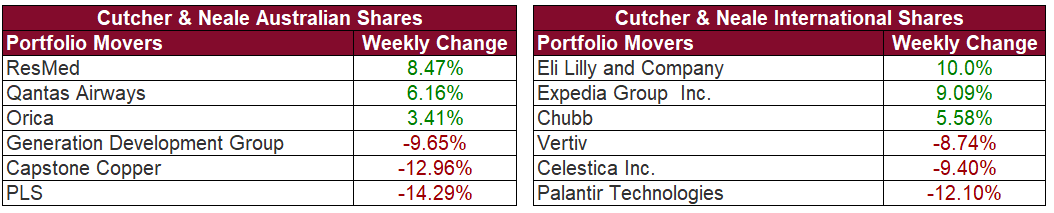
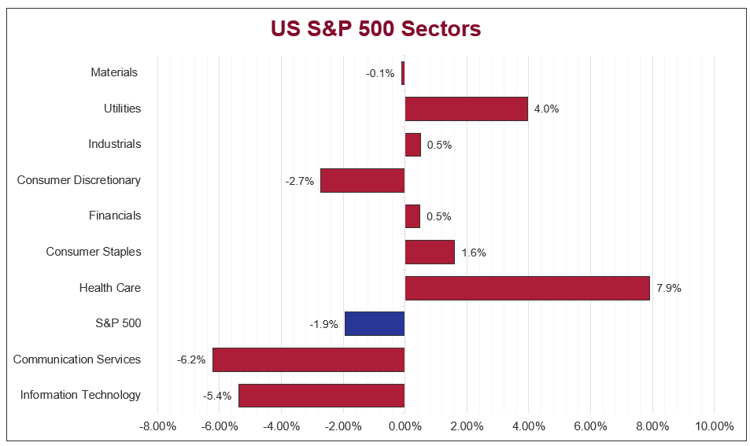
US sharemarkets closed mixed last week, with the S&P 500 (-1.9%) and Nasdaq (-4.6%) weighed down by a sharp rotation out of mega-cap technology, despite continued strength in underlying AI demand. The Information Technology sector (-5.4%) and Communication Services sector (-6.2%) led declines, driven by weakness in key AI names and positioning concerns, although strong semiconductor earnings reaffirmed the durability of the AI capex cycle. In contrast, defensive sectors outperformed, with the Health Care sector (7.9%) and the Utilities sector (4.0%) supported by falling bond yields. Eli Lilly surged 10.0% after regulatory progress on its cancer drug and expanded Medicare access to its weight-loss treatments, reinforcing strong healthcare sector momentum.
European sharemarkets ended the week broadly flat, with the STOXX Europe 600 edging 0.1% higher, although underlying performance reflected shifting macro dynamics. Sentiment was supported by falling energy prices following progress on US‑Iran negotiations, which improved the region’s inflation and growth outlook. This prompted strength in defensive areas, with the Health Care sector (3.8%) outperforming on continued thematic demand. However, cyclical sectors lagged as commodity prices softened, with the Energy sector (-5.3%) and the Basic Resources sector (-4.6%) declining. The Technology sector (-3.9%) also underperformed amid a broader global rotation away from growth stocks and ongoing concerns around AI-related valuations and cost pressures.
Stock & sector movements
What caught our eye
Back to where it all began
Last week the oil price settled at around US$73 a barrel, close to where it sat the day before war broke out in the Middle East. For an event that was meant to reshape the global energy market, the oil price has ended up remarkably close to where it started.
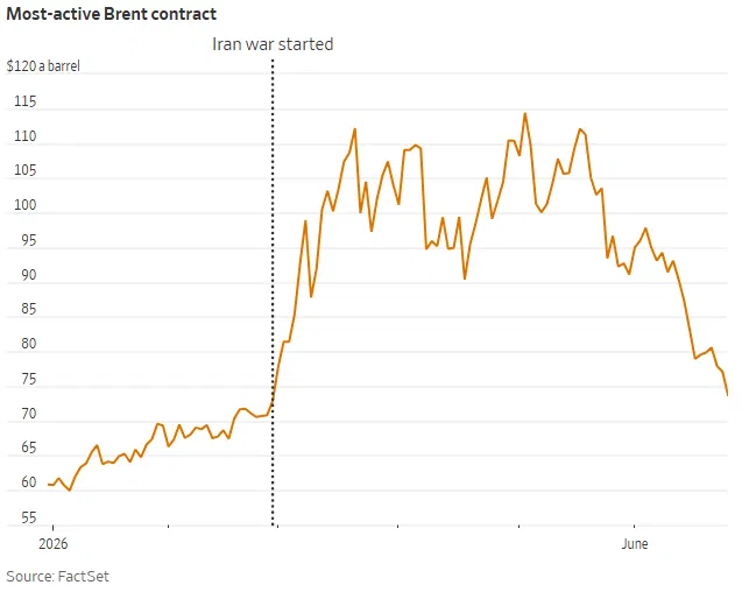
When Israel and the United States struck Iran at the end of February, oil had closed the previous day at US$73. Within a fortnight it had climbed to nearly US$120, and the forecasts climbed with it. Goldman Sachs and Macquarie both raised the prospect of US$150 a barrel. Morgan Stanley and UBS pointed to US$130 to US$150 or higher if the Strait of Hormuz stayed shut. In Bank of America’s worst case, assuming the war lasted all year, the price was projected to reach US$240. The logic behind these calls were sound, they just simply did not come to pass.
The strait that carried 20 million barrels a day before the war fell to a trickle, and yet the world adjusted. The United States lifted its oil exports by close to 4 million barrels a day over the year, and China leaned on its own large stockpiles rather than buying as much from abroad. Analysts think that combination absorbed roughly three quarters of the lost supply. Governments, including Australia, released record volumes from strategic reserves to fill much of the rest.
This is not necessarily a case of the alarmist voices being wrong and the calm ones being right. The strait is still moving only 6-7 million barrels a day, a fraction of its former flow, and the reserves that cushioned the blow have been drawn down hard. Some now argue the recent fall has gone too far, given how tight the physical market remains. The price has returned to its starting point faster than the supply behind it. The honest reading is that the system found an unglamorous workaround and the buffers it used are now thinner than they were.
For investors, the lesson is less about oil and more about forecasts. A confident number attached to a dramatic scenario is compelling, and it is often wrong, because the world tends to adapt in ways that are hard to predict in advance. We did not reposition portfolios around the prospect of US$150 per barrel of oil. The steadier path is to hold a diversified mix that can weather a range of outcomes rather than betting on the most enticing opinion.
The oil price has come full circle and a useful takeaway is to treat every forecast as one possible future rather than a certain one. This is especially important in times such as these, with Donald Trump as president.
The week ahead
Locally, the focus is on Tuesday’s RBA meeting minutes for signals on inflation and rate direction, alongside housing data showing falling prices and weaker auction activity, pointing to softer spending. Markets are also watching US-Iran peace talks and any reopening of the Strait of Hormuz.
US data dominates, with ADP employment (Wed) and nonfarm payrolls (Thu) key for Fed expectations. Strong labour data would reinforce a higher-for-longer rate outlook and support the USD.


Wade is the head of the Investment Services division at Cutcher & Neale and has over 15 years of industry experience in accounting and investment advisory roles.
Wade guides his division on the belief that investment portfolios should be built on transparency and flexibility. His expertise focuses on direct portfolio exposure to both Australian and Global Investment markets.
-1.png?width=352&name=Investment%20SnapShot%20Header%20-%20July%202025%20(1)-1.png)