
-1.png)
Weekly recap
What happened in markets
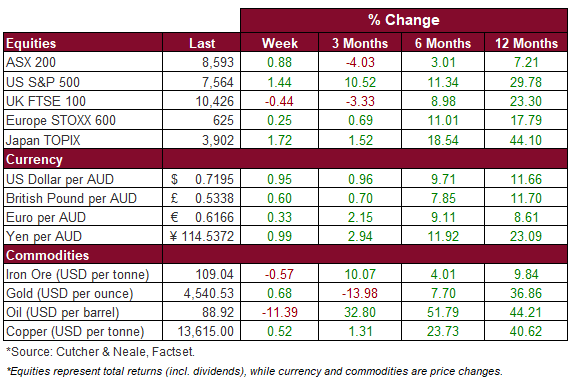
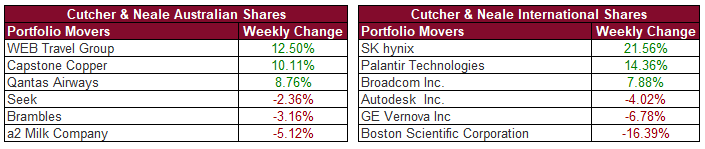
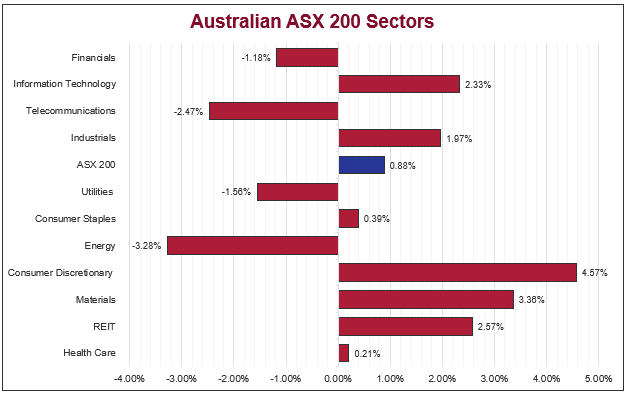
The Australian sharemarket finished the week higher, helped by an 11.39% fall in oil prices amid optimism around US-Iran peace talks. Even so, the ASX 200 remains within its recent trading range, rising 0.88% for the week. Inflation data was the main focus, with April CPI easing more than expected to 4.2%, down from 4.6% in March, signalling a further moderation in domestic inflation. Consumer Discretionary led the market, climbing 4.57%, with Tabcorp Holdings up 14.07% after strong earnings. Materials (3.36%), REITs (2.57%) and Information Technology (2.33%) also posted solid gains, supported by softer inflation figures that increased expectations the RBA may pause future rate hikes for now. On the weaker side, Energy (-3.28%) and Telecommunications (-2.47%) underperformed, with Woodside falling 4.49% after Brent Crude dropped below $100 per barrel.
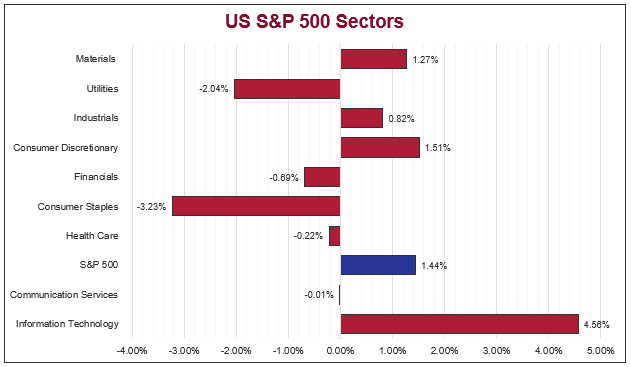
US sharemarkets extended their gains for another week, driven by the Information Technology sector (4.56%), as easing global bond yields, lower oil prices and peace talks improved the macro backdrop. At the same time, rising demand for AI infrastructure and cloud computing, together with strong earnings from semiconductor and hardware companies, continued to drive the technology rally. The S&P 500 rose 1.44% over the week, with tech names such as Super Micro Computer (29.54%) and Micron (29.29%) among the standout performers. In contrast, Energy (-5.43%), Consumer Staples (-3.23%) and Utilities (-2.04%) weighed on the index, with GE Vernova (-6.78%) and Costco (-6.99%) among the weaker performers, as investors continued shifting toward a more risk-on environment.
European markets edged higher over the week, helped by easing US inflation pressures and a softer US Dollar. However, sticky core inflation across major Eurozone economies remains a concern for the outlook for economic growth. Similar to Australia and the US, Energy (-4.43%) was the weakest sector as oil prices fell, followed by Utilities (-2.00%) and Telecommunications (-2.53%). Offsetting this weakness, Retail (3.42%), Travel (3.03%), Basic Resources (2.73%) and Technology (1.28%) sectors supported gains across the region. Infineon Technologies rose 10.47%, driven by strong demand for AI data centres and growing renewable energy investment, both of which increased demand for its semiconductors.
Stock & sector movements
What caught our eye
The AI Buildout Is Now a Results Print
For two years the question around artificial intelligence has been whether the spending would translate into real revenue. Nvidia's latest quarter has answered a meaningful part of that question, and a wave of public listings later this year will test the next.
Nvidia reported revenue of US$81.6 billion for its fiscal first quarter, up 85% on a year earlier and ahead of its own guidance. The forward quarter is guided to roughly US$91 billion, also above what the market was expecting. Data centre revenue grew 92%, with hyperscale cloud customers more than doubling their spend. The networking business, which connects clusters of AI chips together, tripled to almost US$15 billion. Morningstar has lifted its fair value estimate for the company to US$280 a share from US$260, and we agree that the current momentum continues to outrun even bullish expectations.
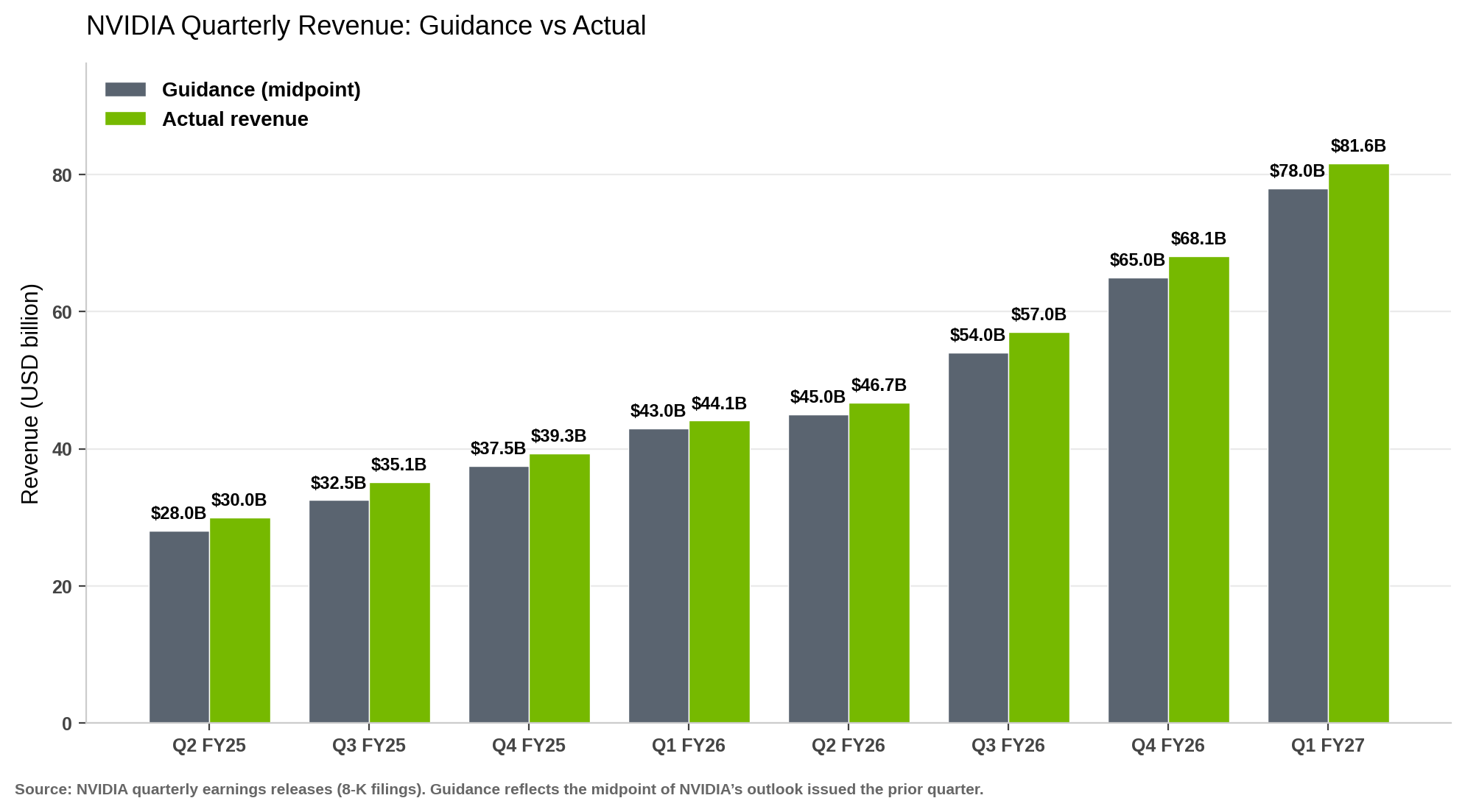
The figures confirm that AI infrastructure spending is not just being announced, it is being delivered and absorbed at scale. The pattern of guidance beats has held for eight consecutive quarters, even as the absolute revenue base has nearly tripled. The hyperscalers are not slowing. Nvidia's customer base outside of the giants, which includes a long tail of smaller cloud providers and enterprises, grew 74% on its own. That breadth is what shifts AI from a story about a handful of buyers into something closer to a broad industry buildout.
It also sets the stage for what could come next. SpaceX filed its prospectus with the SEC last week and is reportedly targeting a Nasdaq listing in June under the ticker SPCX, with reported valuation expectations in the range of US$1.75 trillion to US$2.00 trillion. What is sometimes missed is that SpaceX is no longer purely a rocket business. It has merged with Elon Musk's artificial intelligence company xAI, and now operates the Colossus data centre complex in Memphis as a neocloud, renting compute capacity back out to others. According to SpaceX's IPO filing, Anthropic has agreed to pay US$1.25 billion a month through May 2029 for that capacity.
OpenAI has reportedly been laying the groundwork for a possible listing in the second half of 2026, with valuation expectations discussed around the US$1 trillion mark. Anthropic has also been linked with a potential late 2026 listing, with private market valuation reports around US$900 billion. Both timing and pricing remain subject to change. If they proceed on the reported timelines and valuations, these would form one of the largest clusters of technology listings in market history, and would bring the demand side of the AI economy into the public arena for the first time. Investors would finally have a way to assess not just the suppliers of AI infrastructure but the businesses building on top of it.
Talk of an AI bubble has been a constant for some time now, and for those who held that view it has been a tough few years, because the story has so far played out as one for the history books. Nvidia's result is the latest reassurance that the capital being committed is producing genuine revenue and not press releases. The forthcoming listings will introduce a different test, which is whether the model developers and AI businesses can grow into the valuations the private market has already assigned them. Both readings need to hold for the broader rally in AI to be durable. We remain constructive on selective exposure to the theme through existing positions, and we will be patient and discerning as the new listings price.
The week ahead
Locally, the focus will be on the March quarter GDP figures, with expectations of a 0.5% increase for the quarter. Additionally, we will get Balance of Trade figures on Thursday.
Overseas, attention will turn to US economic data, including ISM Manufacturing PMI on Monday and Non-Farm Payrolls and the Unemployment Rate on Friday. In Europe, inflation rate data will be released on Tuesday, providing an indication of the ECB interest rate decision in the following week.


Wade is the head of the Investment Services division at Cutcher & Neale and has over 15 years of industry experience in accounting and investment advisory roles.
Wade guides his division on the belief that investment portfolios should be built on transparency and flexibility. His expertise focuses on direct portfolio exposure to both Australian and Global Investment markets.
-1.png?width=352&name=Investment%20SnapShot%20Header%20-%20July%202025%20(1)-1.png)