
|
|
Quick TakeMarkets moved in different directions in October: Europe and Australia advanced, with the STOXX Europe 600 rising 1.98% and the ASX 200 gaining 1.38%. In the United States, the S&P 500 fell 0.87% and the Nasdaq dropped 5.28%, while the Russell 2000 rose 0.58%. Concern over funding artificial intelligence investment, oil prices returning above US$100 a barrel and a rally in government bonds shaped the month. The United States saw a rotation rather than a retreat: Artificial intelligence shares fell sharply as attention turned to the cost of the buildout, but investors moved into other parts of the market rather than selling broadly. The Federal Reserve held rates, with markets pricing a December rise after firmer inflation and solid growth, while company earnings remained strong. Europe and Australia moved higher: In Europe, resilient earnings offset French fiscal stress and rising energy prices, as the European Central Bank held rates with a December rise still possible. In Australia, falling commodity prices weighed, while the Reserve Bank warned the inflation outlook had deteriorated. The key question from here is whether artificial intelligence spending can be funded without further strain on markets, and whether higher oil prices push central banks into more rate rises. |
|
Snapshot
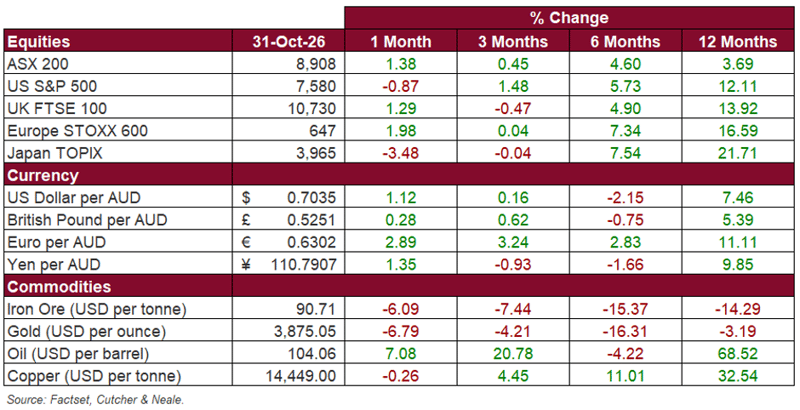 Global equity markets delivered mixed results in October, with a sharp fall in artificial intelligence-related shares weighing on the United States, while Europe and Australia moved higher. In the United States, the S&P 500 fell 0.87%, the Nasdaq dropped 5.28% and the Russell 2000 gained 0.58%. In Europe, the STOXX Europe 600 rose 1.98% and the FTSE 100 gained 1.29%, while the DAX increased 2.46% and the CAC edged up 0.15%. In Australia, the ASX 200 rose 1.38%. Every region was shaped by growing concern over how the artificial intelligence buildout will be funded, the return of oil prices to above US$100 a barrel as tensions between the United States and Iran resurfaced, and a rally in government bonds after long-term yields began the month at multi-decade highs.
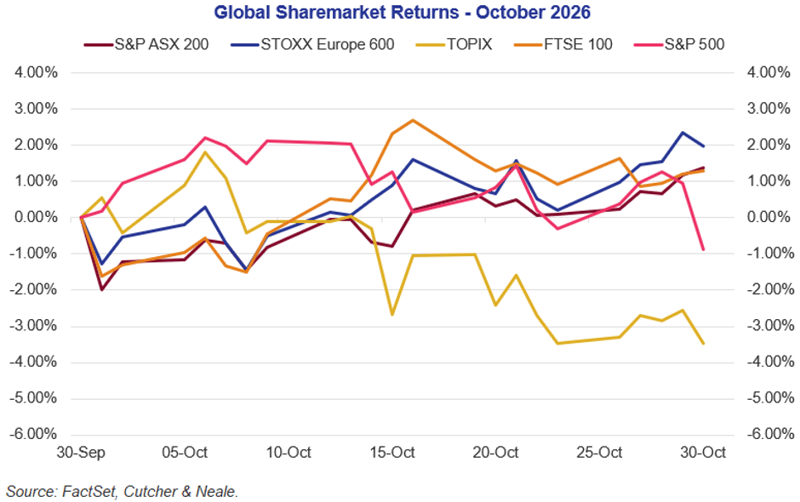
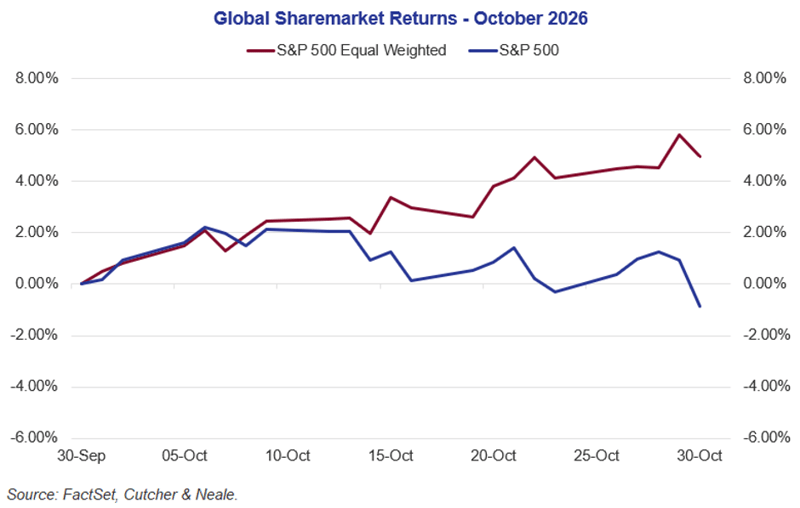
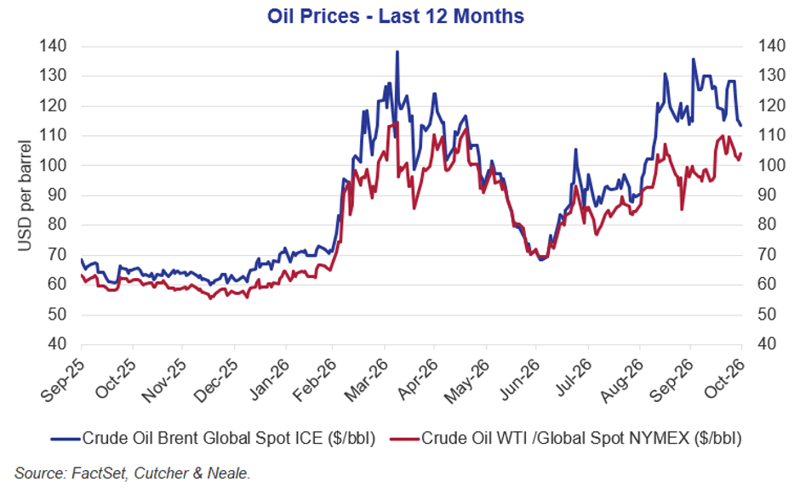
In the United States, the S&P 500 fell 0.87%, a second consecutive monthly decline, and the Nasdaq dropped 5.28%, its weakest month since March 2025. The artificial intelligence debate shifted from demand to financing, as credit stress and very large capital needs across the industry raised questions about the cost of the buildout. Importantly, this drove a rotation rather than a broad retreat, with an equally weighted version of the S&P 500 rising 4.95% as investors moved into more defensive parts of the market. Long-term bond yields started October at 24-year highs before falling sharply. The Federal Reserve held rates as expected, but with core inflation above forecasts and the economy growing at 3.4% in the September quarter, markets priced a 75% chance of a December rise despite weak jobs growth. Oil climbed back above US$100 a barrel on reports of possible renewed US strikes on Iran. Company earnings remained strong, with 82% of reporting companies beating expectations so far.
European markets were more resilient. The STOXX Europe 600 rose 1.98%, with the DAX up 2.46% and the FTSE 100 up 1.29%, while the CAC gained just 0.15% as France came under pressure. Budget uncertainty and civil unrest pushed French 10-Year yields to their highest level since 2002, prompting investors to move into German and UK government bonds, where yields fell. Resilient earnings helped offset rising energy prices, with Brent crude up more than 16% to above US$114 a barrel. The European Central Bank left rates unchanged, citing tighter financing conditions, although a December rise remains possible if inflation does not improve. Eurozone growth surprised on the upside at 0.4% for the September quarter. In the UK, inflation reached an eleven-month high of 3.5% and the Bank of England sounded increasingly hawkish, while a low-key Budget drew a muted bond market reaction.
 In Australia, the ASX 200 rose 1.38% in a choppy month, as company updates and takeover activity were offset by falling commodity prices, with iron ore down 6.09% and gold down 6.79%. Minutes from the Reserve Bank's September meeting reinforced the case for that month's rate rise and left the door open to further tightening, while Deputy Governor Hauser warned the inflation outlook had deteriorated materially. Inflation was slightly firmer than expected in the September quarter, driven largely by higher fuel prices, while employment unexpectedly fell. The Australian Dollar rose 1.12% to US$0.7035 and the 10-Year Government bond yield eased to 5.14% from 5.34%.
Overall, October showed that markets can absorb a sharp setback in their most popular theme, with gains broadening across regions. However, conditions remain challenging, with oil above US$100 a barrel, persistent inflation and central banks leaning towards higher rates. The key question from here is whether artificial intelligence spending can be funded without further strain on markets, and whether higher oil prices push central banks into another round of rate rises.

Key Stocks


Ryan joined Cutcher & Neale as a Portfolio Manager in January 2023, bringing nearly 20 years of financial markets experience to the firm. Specialising in fundamental equity analysis and multi-asset strategies, Ryan holds the Chartered Financial Analyst (CFA) designation. He is responsible for the risk and return outcomes of the firm’s Managed Discretionary Account (MDA) portfolios on the Mason Stevens platform.